
Boiler condensate recovery returns hot condensate from steam users to the feed tank or directly to the boiler. Condensate is clean, hot and already treated – dumping it wastes fuel, water and chemicals. ISE designs, supplies and installs open and closed pressurised condensate recovery systems following European practice (PED 2014/68/EU, EN 13480, EN 12953-10).

Why recover boiler condensate?
- Energy: condensate holds about 20 % of the energy in steam (Forbes Marshall).
- Fuel: rule of thumb – every 6 °C rise in feedwater temperature saves about 1 % fuel. Raising feedwater from 30 °C to 80 °C with condensate saves around 8 %.
- Water and chemicals: less make-up water, softening, deaeration and chemicals; less blowdown and TDS blowdown.
- Operation: faster steam response, less thermal shock, no plumes of flash steam and hot water to drain.
Boiler condensate recovery system layout
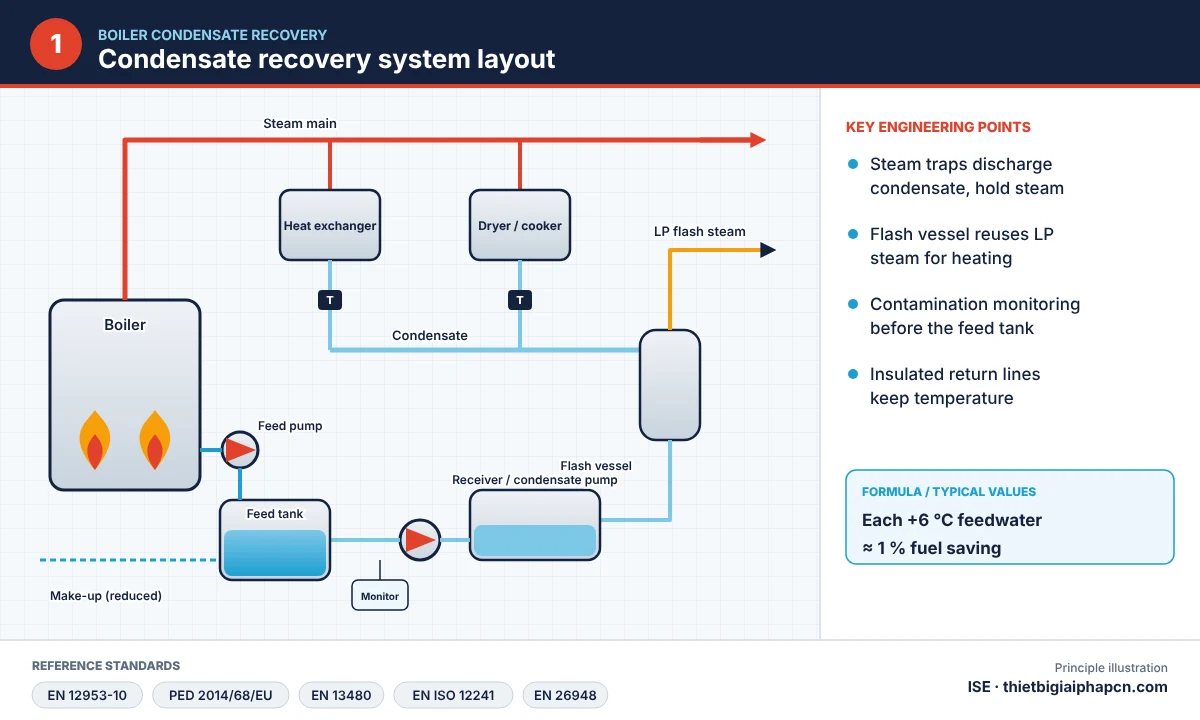
| Component | Function |
|---|---|
| Steam traps | Discharge condensate, hold steam; test regularly to avoid steam loss |
| Condensate piping | Designed to EN 13480, sized for flash steam, insulated to EN ISO 12241 |
| Flash vessel | Separates LP steam for heating and drying |
| Receiver and condensate pump | Electric pump or pressure-powered pump (PPP) returns condensate |
| Contamination monitor | Detects oil, sugar, chemicals; automatically dumps bad condensate |
| Feed tank / deaerator | Receives condensate, mixes make-up, feeds the boiler |
Energy in condensate and flash steam
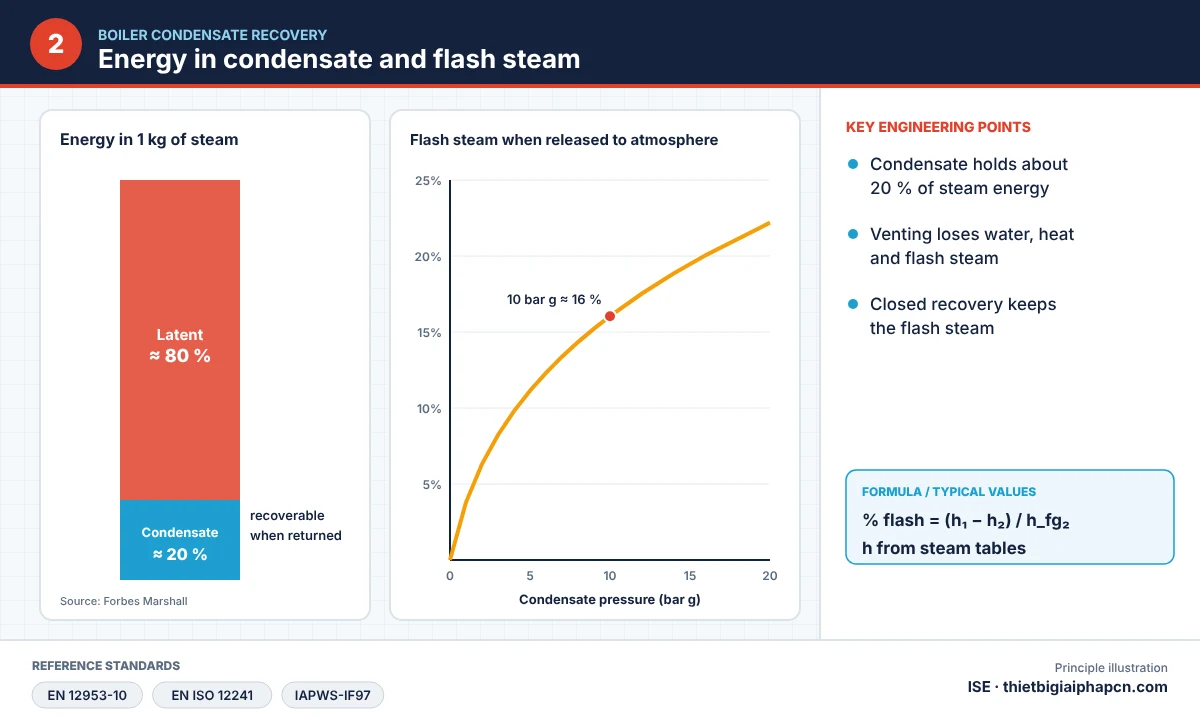
When high-pressure condensate is released to lower pressure, part of it flashes to steam: % flash = (h₁ − h₂) / h_fg₂. Condensate at 10 bar g released to atmosphere flashes about 16 % by mass (from saturated steam tables). Open systems lose this steam; closed systems or flash vessels reuse it.
Open versus closed pressurised condensate return
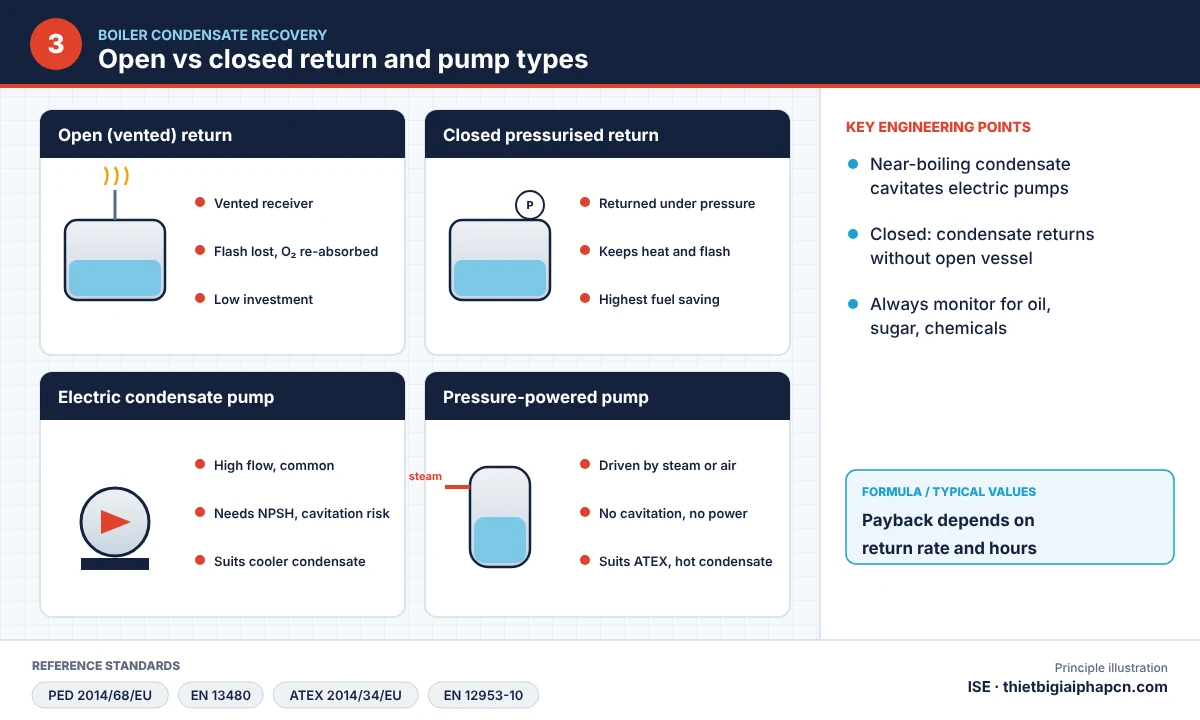
| Solution | Advantages | Considerations |
|---|---|---|
| Open (vented receiver) | Low cost, simple | Flash steam lost, O₂ re-absorbed, electric pumps may cavitate |
| Closed pressurised | Keeps heat and flash steam, condensate returned without depressurising; highest fuel saving | Higher investment, system pressure design |
| Electric condensate pump | High flow, common | Needs NPSH; near-boiling condensate causes cavitation |
| Pressure-powered pump (PPP) | No cavitation, no electricity, suits ATEX areas | Uses a little steam or compressed air |
Controlling recovered condensate quality
Returned condensate must meet feedwater requirements of EN 12953-10 (e.g. oil and grease < 1 mg/l). Heat exchanger leaks can carry oil, sugar or chemicals – see condensate contamination control. Combine with boiler deaeration to handle O₂ and CO₂.
EU standards for boiler condensate recovery
| Standard | Scope |
|---|---|
| PED 2014/68/EU | Pressure equipment: flash vessels, receivers, pressure-powered pumps |
| EN 13480 | Metallic industrial piping |
| EN ISO 12241 | Thermal insulation calculation for equipment and piping |
| EN 26948 / EN 27841 | Steam trap production, operating and steam-loss tests |
| EN 12953-10 | Feedwater and boiler water quality |
| ATEX 2014/34/EU | Equipment in explosive atmospheres |
Benefits of ISE condensate recovery
- Fuel savings from hot feedwater and flash steam reuse.
- Less make-up water, treatment chemicals and blowdown.
- Faster, more stable steam supply.
- Low maintenance; payback depends on return rate, pressure and running hours – ISE calculates it during the survey.
Project steps
- Survey steam users, traps, condensate quantity, pressure and distance to the boiler house.
- Calculate flash steam; choose open or closed return and electric or pressure-powered pumps.
- Design piping, flash vessel, insulation and contamination monitoring.
- Install, commission, measure feedwater temperature and verify savings.
FAQ
Why do electric condensate pumps fail?
Near-boiling condensate leaves too little suction head (NPSH), causing cavitation that destroys the impeller. Raise the receiver, cool slightly or use a pressure-powered pump.
Can condensate go straight to the boiler?
Yes, with a closed pressurised system when condensate is clean and monitored – recovering the most heat and flash steam.
Related
Contact ISE about condensate recovery
EQUIPMENT INDUSTRIAL SOLUTION CO., LTD (ISE) – Ho Chi Minh City, Vietnam.
Contact us: Sales +84 909 617 185 – Technical +84 979 117 185 – Email: [email protected]


