
Boiler deaeration removes dissolved oxygen (O₂) and CO₂ from feedwater before it enters the boiler. It is the most important corrosion control step in a steam system: it prevents pitting, extends boiler life, cuts chemical use and saves fuel through hot feedwater. ISE advises on, supplies and integrates boiler deaeration systems that meet feedwater requirements of EN 12953-10 / EN 12952-12.

Why is boiler deaeration needed?
- Dissolved O₂ causes pitting in economisers, fire tubes and water tubes – localised corrosion that perforates quickly.
- CO₂ carried with steam forms carbonic acid that attacks condensate return lines.
- Cold feedwater causes thermal shock and higher fuel use.
Under EN 12953-10 (shell boilers), feedwater for boilers at 0.5–20 bar must contain O₂ < 0.05 mg/l, and < 0.02 mg/l above 20 bar; where this cannot be achieved (intermittent operation, no deaerator) film-forming agents or excess oxygen scavenger must be used.
| Feedwater parameter (EN 12953-10) | 0.5 – 20 bar | > 20 bar |
|---|---|---|
| Dissolved O₂ | < 0.05 mg/l | < 0.02 mg/l |
| pH at 25 °C | > 9.2 | > 9.2 |
| Hardness (Ca + Mg) | < 0.01 mmol/l | < 0.01 mmol/l |
| Iron (Fe) | < 0.3 mg/l | < 0.1 mg/l |
| Copper (Cu) | < 0.05 mg/l | < 0.03 mg/l |
| Oil, grease | < 1 mg/l | < 1 mg/l |
How boiler deaeration works
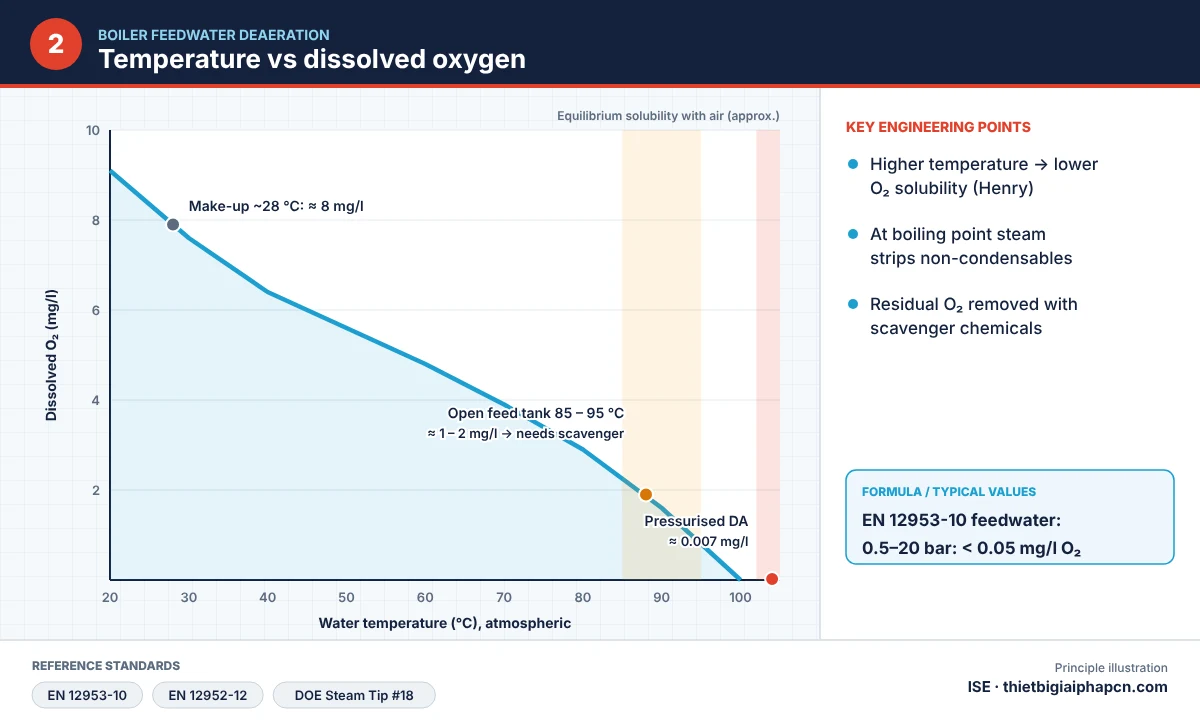
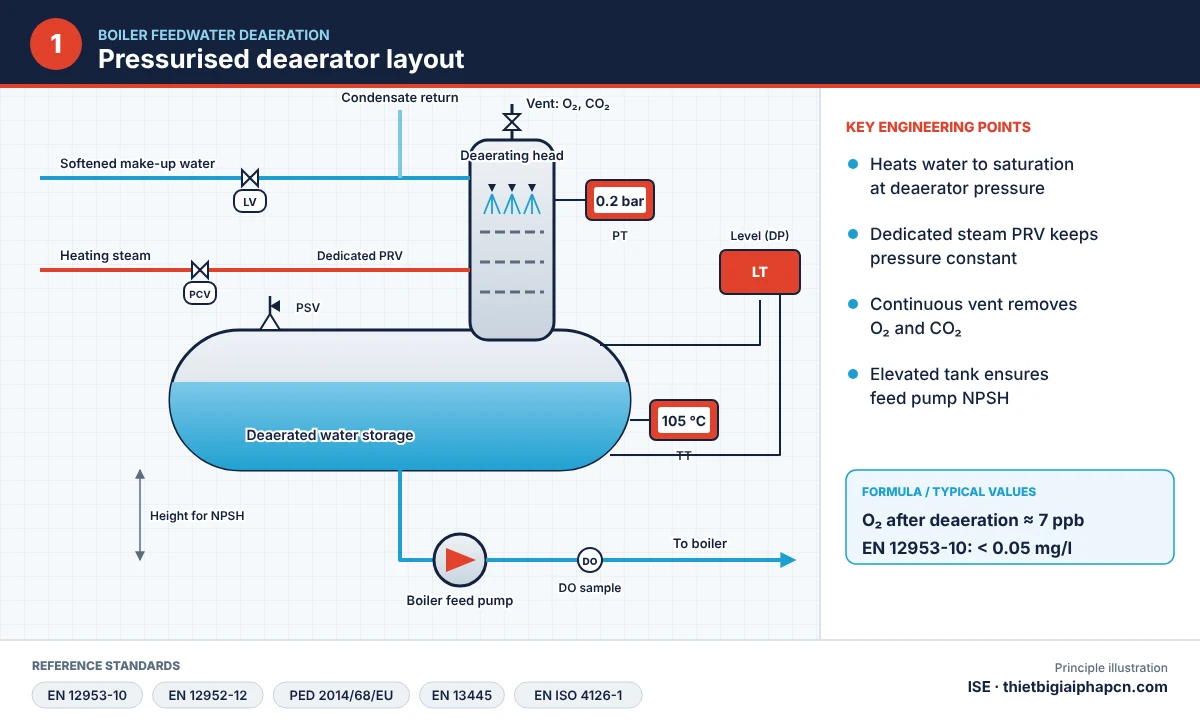
By Henry’s law, gas solubility in water falls as temperature rises. A deaerator uses steam to heat water to saturation at deaerator pressure while spraying or dividing it to increase contact area; O₂ and CO₂ are released and continuously vented. Pressurised deaerators reach about 7 ppb O₂; boilers above 200 psi (≈ 14 bar) typically need ≤ 5 ppb (DOE Steam Tip Sheet #18). Residual O₂ is removed with scavenger chemicals.
Pressurised deaerator components
| Component | Function |
|---|---|
| Deaerating head | Spray nozzles and/or trays where water meets steam and releases gases |
| Storage tank | Holds deaerated water, elevated to provide feed pump NPSH |
| Steam pressure control valve (PCV) | Keeps pressure constant; pressure swings let water re-absorb O₂ |
| Make-up water valve (LV) | Controlled from tank level measured by a DP transmitter |
| Vent valve, safety valve (PSV) | Vents non-condensables; overpressure protection to EN ISO 4126-1 |
| Instruments | Pressure, temperature, level; dissolved O₂ sample point |
Boiler feedwater deaeration options
| Type | Conditions | O₂ after treatment | Best for |
|---|---|---|---|
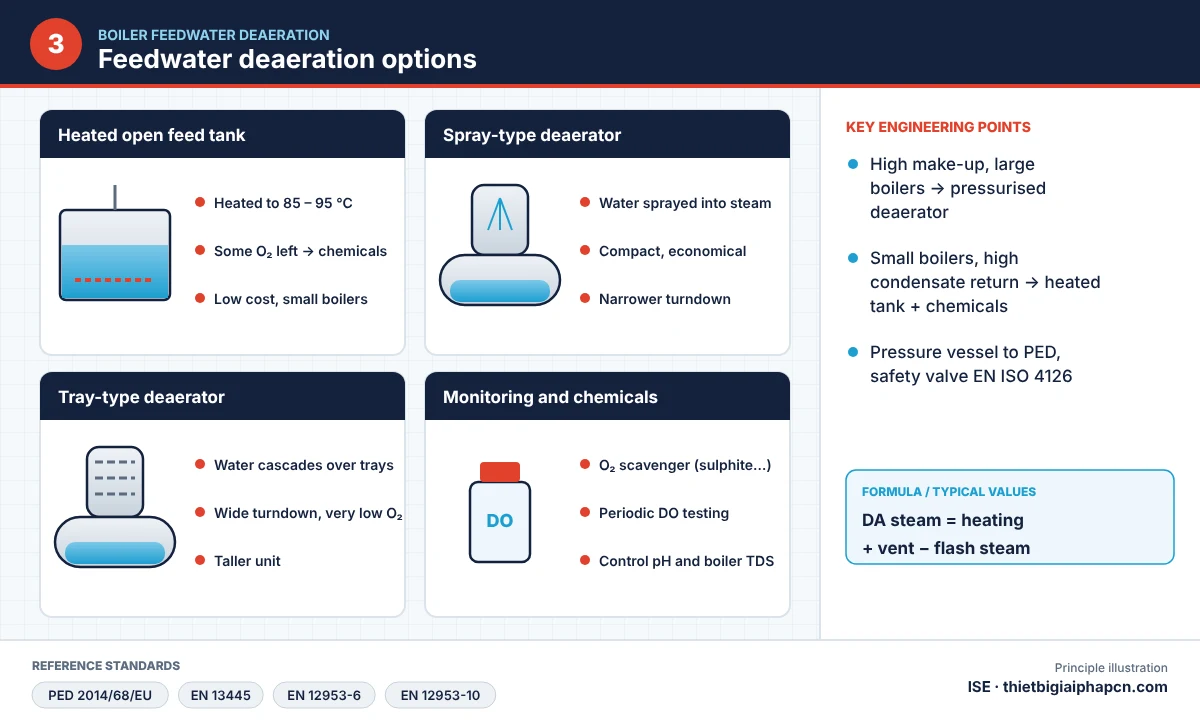
| Heated open feed tank | 85 – 95 °C, atmospheric | About 1 – 2 mg/l O₂ left, needs chemicals | Small boilers, high condensate return |
| Spray-type pressurised deaerator | ≈ 105 °C, slight overpressure | Very low O₂ | Compact, fairly steady load |
| Tray-type pressurised deaerator | ≈ 105 °C, slight overpressure | Very low O₂, wide turndown | Large boilers, variable load |
Control and operation
- Pressure: a dedicated steam PRV holds deaerator pressure constant; avoid sudden flash-steam surges.
- Level: a differential pressure sensor measures tank level and drives the make-up valve; low-level alarm protects the feed pump.
- Vent: open enough to remove non-condensables; vent steam increases with cold, high make-up.
- O₂ testing: stop scavenger feed for 12 – 24 h, sample through a stainless sample cooler, test repeatedly to assess performance.
- Insulate the head, tank and hot piping.
EU standards for boiler deaeration
| Standard | Scope |
|---|---|
| EN 12953-10 | Feedwater and boiler water quality for shell boilers |
| EN 12952-12 | Feedwater and boiler water quality for water-tube boilers |
| PED 2014/68/EU, EN 13445 | Design and manufacture of pressure vessels |
| EN ISO 4126-1 | Safety valves |
| EN 12953-6 | Equipment requirements for shell boilers |
Benefits of boiler deaeration
- Less pitting, longer boiler and condensate line life.
- Lower scavenger dosing and chemical cost.
- Hot feedwater: no thermal shock, fuel savings, recovery of condensate and flash steam.
- Combine with boiler TDS control and condensate contamination control for full protection.
ISE services
- Survey boiler, make-up and condensate return, feedwater quality.
- Heat balance; select deaerator type and capacity.
- Supply pressure and level control valves, pressure, temperature and level instruments, control panel.
- Installation, commissioning, dissolved O₂ testing, operator training.
FAQ
Are chemicals still needed with a deaerator?
A small scavenger dose is still used for residual O₂ and load swings, but far less than without deaeration.
Does a heated open feed tank meet EN 12953-10?
Heating to 85 – 95 °C only lowers O₂ to about 1 – 2 mg/l, not < 0.05 mg/l; oxygen scavenger or a pressurised deaerator is required.
Related
Contact ISE about boiler deaeration
EQUIPMENT INDUSTRIAL SOLUTION CO., LTD (ISE) – Ho Chi Minh City, Vietnam.
Contact us: Sales +84 909 617 185 – Technical +84 979 117 185 – Email: [email protected]


