
Boiler feedwater control keeps the water level in the drum or shell stable at every load. Water is the lifeblood of a boiler: losing level control can expose heating surfaces, overheat the metal and – if cold water is pumped into a red-hot boiler – generate steam so violently that the boiler may explode. ISE supplies continuous feedwater control and water level safety limiters following European practice (EN 12953-6, EN 12953-9, EN 12953-10).
Why boiler feedwater control matters
- Low level: exposed fire tubes or water tubes, overheating, deformation, explosion risk.
- High level: carryover, wet steam, deposits and water hammer in steam lines.
- Level swings: batches of cold water cause pressure dips, priming, poor steam quality and shorter pump life.
Feedwater and boiler water quality
The former BS 2486 has been replaced by EN 12953-10 (shell boilers) and EN 12952-12 (water-tube boilers). Reference values for 0.5 – 20 bar boilers with feedwater conductivity > 30 µS/cm:
| Water | Main requirements (EN 12953-10) |
|---|---|
| Feedwater | Clear, no suspended solids; O₂ < 0.05 mg/l; hardness < 0.01 mmol/l; pH > 9.2; Fe < 0.3 mg/l; oil < 1 mg/l |
| Boiler water | Clear, no stable foam; conductivity < 6,000 µS/cm; pH 10.5 – 12.0; alkalinity 1 – 15 mmol/l; phosphate 10 – 30 mg/l |
Hardness causes scale and tube failure; O₂ causes pitting. Combine water treatment, boiler deaeration and TDS control to stay within limits.
ON/OFF versus continuous boiler feedwater control
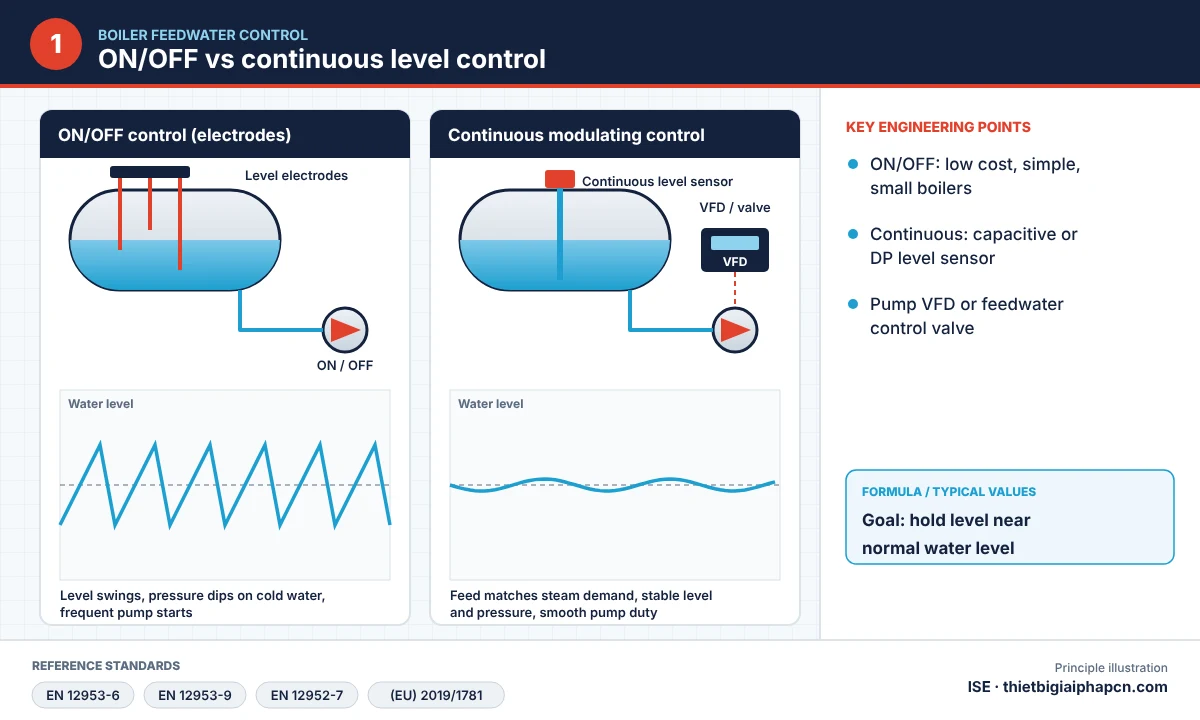
ON/OFF electrode control
Level electrodes (or floats) start the pump at low level and stop it at high level.
- Pros: simple, low cost, easy to install.
- Cons: fluctuating level; large batches of cold water cause pressure dips and priming; frequent pump starts shorten pump and switchgear life.
Continuous (modulating) feedwater control
A capacitive boiler level probe or differential pressure sensor measures level continuously; the PLC/controller modulates a feedwater control valve (pump running) or a pump VFD.
- Pros: feed matches steam demand; no pressure dips or priming; smooth pump duty; fewer level incidents; energy savings with VFDs.
- Cons: higher investment.
Single, two and three-element boiler feedwater control
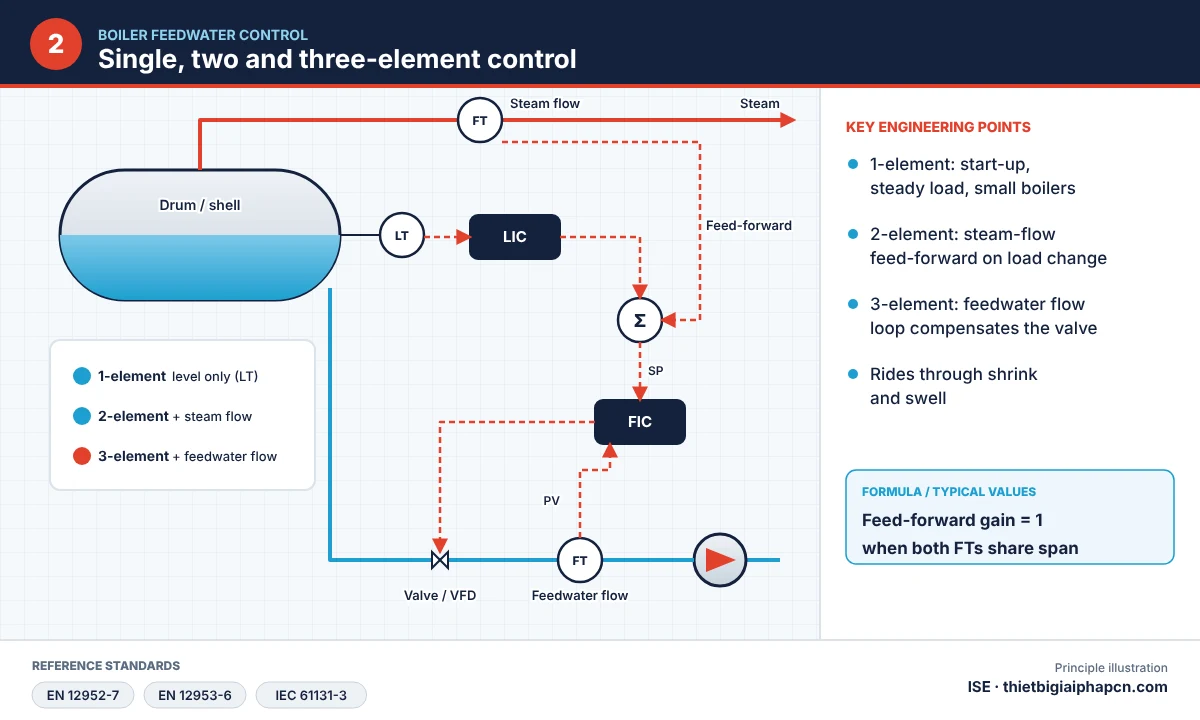
| Strategy | Signals | Best for |
|---|---|---|
| Single-element | Level (LT) only → valve/VFD | Start-up, steady load, small boilers |
| Two-element | Level + steam flow feed-forward | Variable load, one boiler per pump, constant feed pressure |
| Three-element | Level + steam flow + feedwater flow loop | Large boilers, strong load swings, shared feed pumps |
When load rises, drum pressure falls and steam bubbles make the level swell; when load falls or cold water is added, the level shrinks. Single-element control reacts the wrong way; steam-flow feed-forward matches feed to demand, and the feedwater flow loop compensates for valve non-linearity – the most common strategy (Control Engineering).
Water level safety limiters
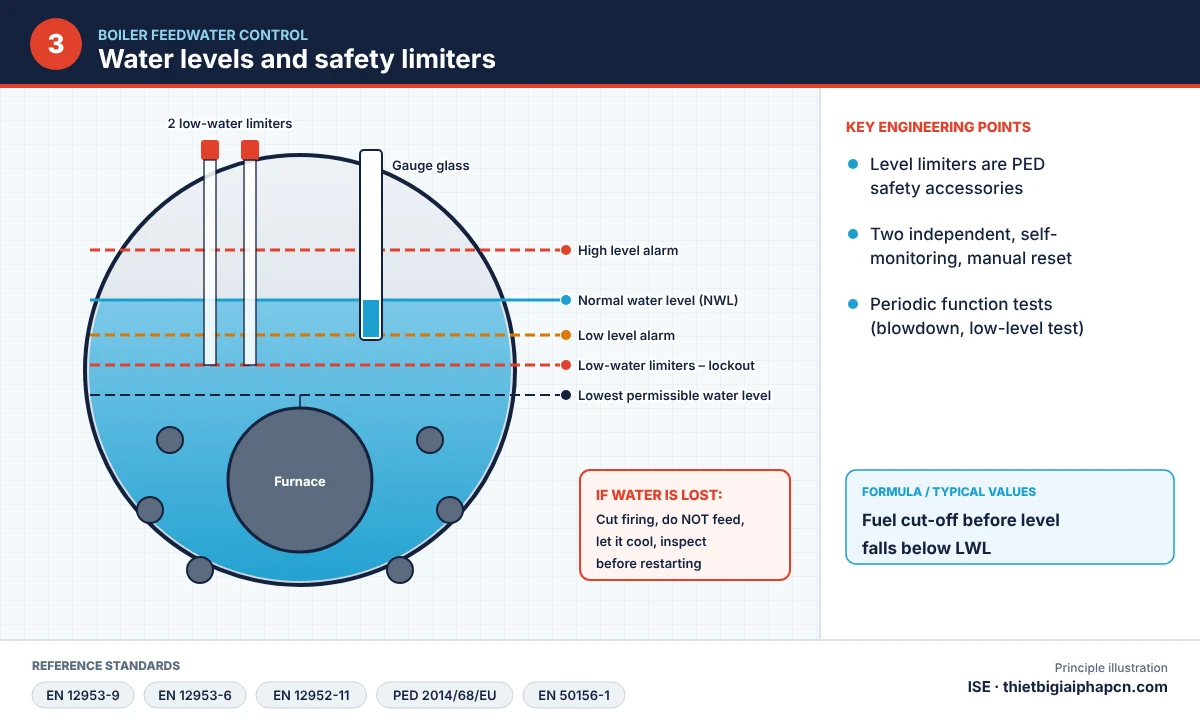
- Water level limiters are safety accessories under PED 2014/68/EU, with requirements in EN 12953-9 (shell boilers) and EN 12952-11 (water-tube boilers).
- Use two independent, self-monitoring low-water limiters that cut and lock out firing, with manual reset only.
- Levels: high alarm, normal water level, low alarm, firing cut-off – always above the lowest permissible water level.
- Test periodically and cross-check with gauge glasses and a boiler drum level measurement system.
If low water is found: shut off firing immediately, do not feed water, let the boiler cool naturally and have it inspected by a competent person before restarting.
EU standards for boiler feedwater control
| Standard | Scope |
|---|---|
| EN 12953-6 | Safety equipment requirements for shell boilers |
| EN 12953-9 / EN 12952-11 | Limiting devices (water level, pressure, temperature) |
| EN 12953-10 / EN 12952-12 | Feedwater and boiler water quality |
| PED 2014/68/EU | Safety accessories and pressure equipment |
| EN 50156-1 | Electrical equipment of furnaces, safety circuits |
| Regulation (EU) 2019/1781 | IE3/IE4 motors, IE2 drives for feed pumps |
ISE boiler feedwater control solution
- Survey boiler, feed pumps, level instruments and existing panel.
- Select continuous level sensors (capacitive, DP) and steam/feedwater flowmeters for 2- or 3-element control.
- Supply pump VFDs or control valves and self-monitoring low-water limiters.
- PLC programming, HMI alarms and data logging; commissioning, PID tuning, safety trip tests.
- Operator training and low-water emergency procedure.
FAQ
Does a small boiler need three-element control?
Not necessarily. Small boilers with steady load usually do well with continuous single-element control and a VFD; two- or three-element control suits strongly varying loads.
VFD or control valve?
VFDs save energy and reduce wear; control valves respond quickly and suit several boilers sharing pumps. Both can be combined.
Related
Contact ISE about boiler feedwater control
EQUIPMENT INDUSTRIAL SOLUTION CO., LTD (ISE) – Ho Chi Minh City, Vietnam.
Contact us: Sales +84 909 617 185 – Technical +84 979 117 185 – Email: [email protected]


