

A TDS sensor (total dissolved solids sensor) is a probe that measures the electrical conductivity of boiler water, from which the concentration of dissolved salts (ppm) is derived to control an automatic TDS blowdown valve. ISE supplies complete boiler TDS sensors, controllers, blowdown valves and probe fittings from leading European brands such as Gestra (Germany) and ViRA (Turkey) for fire-tube boilers, water-tube boilers and feedwater tanks.
Why does a boiler need a TDS sensor?
As a boiler generates steam, impurities in the feedwater that do not leave with the steam concentrate in the boiler water. As TDS rises, surface bubbles become more stable, the steam space fills with foam and water is carried over with the steam. Consequences:
- Wet, contaminated steam fouls control valves, heat exchangers, steam traps and the entire pipework.
- Scale and corrosion on heat-transfer surfaces reduce efficiency and boiler life.
- Manual blowdown by guesswork: too little and TDS exceeds the limit, too much and hot water, chemicals and fuel are wasted.
A boiler TDS sensor measures continuously so that only the necessary amount is blown down, keeping TDS stable around the setpoint – significant fuel and treated-water savings compared with manual blowdown.
How a TDS sensor system works

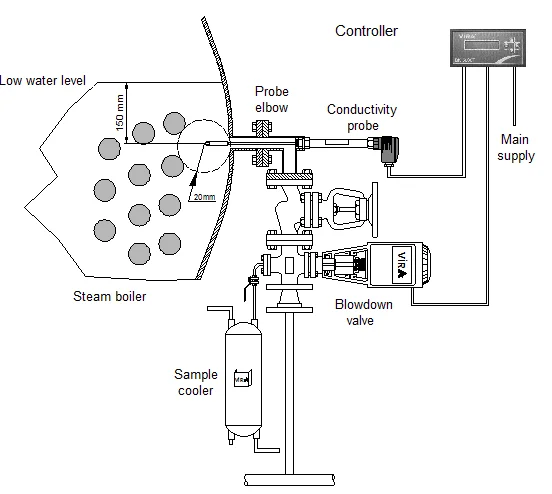
- The conductivity probe mounted in a fitting on the boiler measures conductivity (µS/cm) and water temperature via an integrated temperature sensor.
- The TDS controller automatically compensates to the 25 °C reference temperature, displays the live value and compares it with the setpoint.
- When conductivity exceeds the setpoint, the controller opens the TDS blowdown valve; when it falls below, the valve closes.
- Optional 4–20 mA / Modbus signals go to the PLC or SCADA for remote water-quality monitoring.
Key advantages
- Continuous measurement, fast response and automatic compensation to 25 °C for accurate results at all boiler loads.
- High temperature and pressure rating: works directly in boiler water up to 238 °C and 32 bar.
- Usable as a limit switch or as a continuous 4–20 mA transmitter.
- Complete matched package: probe – controller – valve – fitting, easy for new installations or replacements.
- Genuine Gestra, ViRA and other brands with CO/CQ, warranty and local technical support.
TDS sensor specifications

| Parameter | Value |
|---|---|
| Measured variable | Boiler water conductivity (µS/cm) converted to TDS (ppm) |
| Range | 0 – 4,000 ppm, 0 – 10,000 ppm (10 – 10,000 µS/cm depending on model) |
| Temperature compensation | Automatic to 25 °C (probe with integrated temperature sensor) |
| Max. operating temperature | 238 – 239 °C |
| Max. operating pressure | 32 bar g |
| Connection | Thread or flange (via probe fitting) |
| Output | 4–20 mA; relay for blowdown valve; Modbus RTU (optional) |
| Controller supply | 230 VAC |
| Ingress protection | IP54 or higher |
TDS blowdown valve supplied with the TDS sensor
The TDS blowdown valve receives commands from the controller to discharge high-TDS boiler water. Reference data for a ViRA electric TDS blowdown valve:
| TDS valve | Value |
|---|---|
| Max. operating temperature | 239 °C |
| Max. operating pressure | 32 bar g |
| Nominal pressure | PN40 |
| Body material | Nodular cast iron GGG40 |
| Connection | DN20 flanged |
| Weight | 10 kg |
| Valve actuator | Value |
|---|---|
| Power supply | 230 V, 50 Hz |
| Power consumption | 15 VA |
| Full open/close time | 120 s |
| Ingress protection | IP54 |
| Max. temperature | 150 °C |
| Operating modes | Automatic (default) or manual via hand lever – red “MAN” indicator |
| TDS probe fitting | Value |
|---|---|
| Body material | Nodular cast iron GGG40 |
| Boiler and valve connection | DN20 flanged |
| Probe connection | 1/2″ BSP thread |
| Pressure / temperature | PN40 – 32 bar g – 239 °C |
DN20 valve blowdown capacity by boiler pressure
| Boiler pressure (bar g) | Blowdown capacity (kg/h) |
|---|---|
| 3 | 525 |
| 5 | 750 |
| 7 | 1,200 |
| 10 | 1,500 |
| 12 | 1,550 |
| 15 | 1,650 |
Correct installation
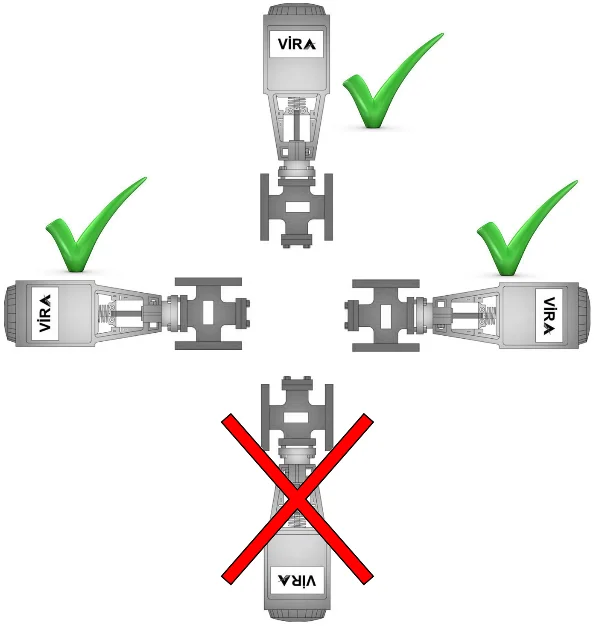
- Install the probe fitting on the boiler first, then fit the TDS probe and blowdown valve to the fitting.
- Mount the valve vertically or tilted up to 90° left/right; never upside down.
- Follow the flow-direction arrow on the valve body.
- Wire the actuator with ordinary 1 mm² cable.
- Isolate power, depressurise and allow to cool before installation or maintenance; work must be carried out by qualified personnel.
Applications
- Continuous (surface / TDS) blowdown control for fire-tube and water-tube boilers firing coal, biomass, oil or gas.
- Monitoring feedwater and returning condensate quality.
- Food, textile, paper, chemical and pharmaceutical plants and industrial parks with boiler houses.
FAQ
How is a TDS sensor different from a conductivity sensor?
Essentially the same: the probe measures conductivity (µS/cm) and the controller converts it to TDS (ppm) using a factor for boiler water.
What TDS setpoint should be used?
It depends on boiler type and working pressure – usually per the boiler manufacturer’s recommendation or boiler water quality standards such as EN 12953-10. ISE advises on the setpoint during the survey.
Can it replace components in existing Gestra or ViRA systems?
Yes. ISE supplies compatible replacement probes, controllers and blowdown valves; send a photo of the existing nameplate for accurate advice.
Related products and solutions
- Automatic boiler TDS blowdown control
- Boiler drum level measurement system
- Liquid level controller relay
- Boiler oxygen trim control for fuel savings
Where to buy boiler TDS sensors?
EQUIPMENT INDUSTRIAL SOLUTION CO., LTD (ISE) – Ho Chi Minh City, Vietnam – supplies genuine boiler TDS sensors with technical consulting, fast quotation and on-site commissioning support across Vietnam and Southeast Asia.
Contact us: Sales +84 909 617 185 – Technical +84 979 117 185 – Email: [email protected]


