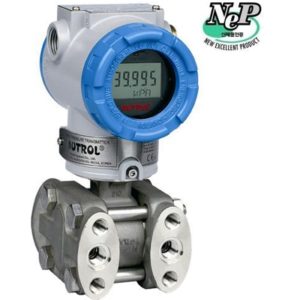
A differential pressure sensor (DP transmitter) measures the difference between two pressures and converts it to a 4–20 mA / HART signal for PLC and DCS systems. From one DP value engineers derive liquid level, flow, filter clogging, furnace draft and cleanroom pressure. ISE supplies European-standard DP sensors from a few tens of Pa to over 20 MPa, static pressure up to 32 MPa and ATEX versions – from CST-Instruments, Yokogawa, ABB, Autrol and others.
What is a differential pressure sensor? Working principle
The device has two ports: H (high) and L (low). Pressure on each side acts on isolating diaphragms and is transmitted through fill fluid (silicone or fluorinated oil) to the sensing element; ΔP = PH − PL changes its capacitance or resistance. The electronics digitise the signal (18-bit A/D), linearise and temperature-compensate it, and output linear or square-root 4–20 mA with HART for remote configuration.
| Sensor technology | Principle | Characteristics |
|---|---|---|
| Capacitive | Diaphragm forms a capacitor plate; ΔP changes plate spacing | Long-term stability, good overpressure tolerance; common in HART transmitters |
| Piezoresistive silicon | Diffused resistor bridge on a silicon chip strains with ΔP | Sensitive, fast; high-end types integrate static-pressure and temperature compensation |
| Ceramic / thin film | Ceramic or metal diaphragm with bonded resistors | Economical for medium ranges |
Types by range and application
- Low DP for air: ±50 Pa to ±10 kPa for cleanrooms, HVAC, filters, furnace draft – see the CST-MDP low DP transmitter.
- Industrial 4–20 mA HART DP transmitter: 1.5 kPa – 20 MPa, static to 32 MPa for level, flow and boilers – see the CST305X-DPT.
- Flanged / capillary remote seal: for viscous, corrosive, crystallising or hot media and closed-tank level.
- Explosion-proof: intrinsically safe Ex ia or flameproof Ex d per ATEX 2014/34/EU and IEC/EN 60079.
Typical applications
- Boiler drum level, open and closed tank level (dry leg, wet leg).
- Steam, gas and liquid flow with orifice plates and venturis per ISO 5167.
- Pressure drop across bag filters, AHU filters, oil and water filters.
- Furnace draft for boilers and dryers; cleanroom pressure per EU GMP Annex 1.
More: 10 DP transmitter applications to EU standards.
Reference specifications
| Parameter | Value |
|---|---|
| Ranges | 0–0.1…1.5 kPa; 0–7.5 kPa; 0–37.4 kPa; 0–186.8 kPa; 0–690 kPa; 0–2,068 kPa; 0–6,890 kPa; 0–20,680 kPa |
| Max. static pressure | 14 MPa / 25 MPa / 32 MPa |
| Output | 4–20 mA + HART®, linear or square-root |
| Sensor | Capacitive or piezoresistive silicon, 18-bit A/D |
| Diaphragm | 316L stainless, Hastelloy C |
| Fill fluid | Silicone oil; fluorinated oil (oxygen, chlorine) |
| Display | LCD: value, %, loop current, sensor temperature |
| Connection | ¼” NPT female; flanges, 3-/5-valve manifolds |
| Explosion protection | Ex ia IIC T4–T6; Ex d IIC T4–T6 (optional) |
| Cable entry | M20 × 1.5 |
Reference data for the CST305X-DPT series; accuracy and approvals per nameplate and certificates supplied.
How to select a DP sensor
- DP range: working ΔP at about 50–80 % of range; mind the turndown ratio – the smaller the set span relative to the sensor range, the larger the error.
- Static pressure: line or vessel pressure must be below the rated static pressure.
- Total probable error (TPE): compare products on TPE at your conditions (reference accuracy plus temperature and static-pressure effects), not reference accuracy alone.
- Medium & temperature: diaphragm, fill fluid; remote seals for hot or corrosive media.
- Signal & area: 4–20 mA/HART, square-root for flow; Ex ia / Ex d in hazardous areas.
Installation guidelines

- Keep impulse lines short; keep H and L legs at the same temperature.
- Liquid/steam: slope up to the tap at least 1:12; gas: slope down at least 1:12.
- Steam: mount below the taps and fill impulse lines with water before start-up.
- Use a 3-valve manifold for isolation, equalising and zeroing.
- No high-voltage megger on the signal loop (max. 100 VDC).
FAQ
DP sensor vs pressure sensor?
A pressure transmitter measures against atmosphere or vacuum; a DP sensor measures the difference between two points, even at very high static pressure.
What is turndown?
The ratio of the sensor’s maximum range to the configured span. Large turndown increases error – choose a range code close to the span you need.
Can it measure flow?
Yes, with an orifice plate, venturi or annubar; select square-root output for a signal linear with flow.
Related products
- CST305X-DPT 4–20 mA HART DP transmitter
- CST-MDP low DP transmitter for cleanrooms and HVAC
- FZ30 3-valve manifold
- DP boiler drum level system
Where to buy differential pressure sensors?
EQUIPMENT INDUSTRIAL SOLUTION CO., LTD (ISE) – Ho Chi Minh City, Vietnam – supplies genuine DP sensors with range selection, accessories and on-site configuration.
Contact us: Sales +84 909 617 185 – Technical +84 979 117 185 – Email: [email protected]
Reference: Comparing differential pressure transmitter accuracy (Process Online).