
Shinko temperature sensors come in two main lines: type K thermocouples (TC-E) for high temperatures up to about 1,200 °C and Pt100 RTDs (TC-R) for accurate measurement in the low-to-medium range. ISE supplies Shinko temperature sensors in the lengths and diameters you need, with thermowells and signal converters, in line with European standards EN 60584-1 and EN 60751.
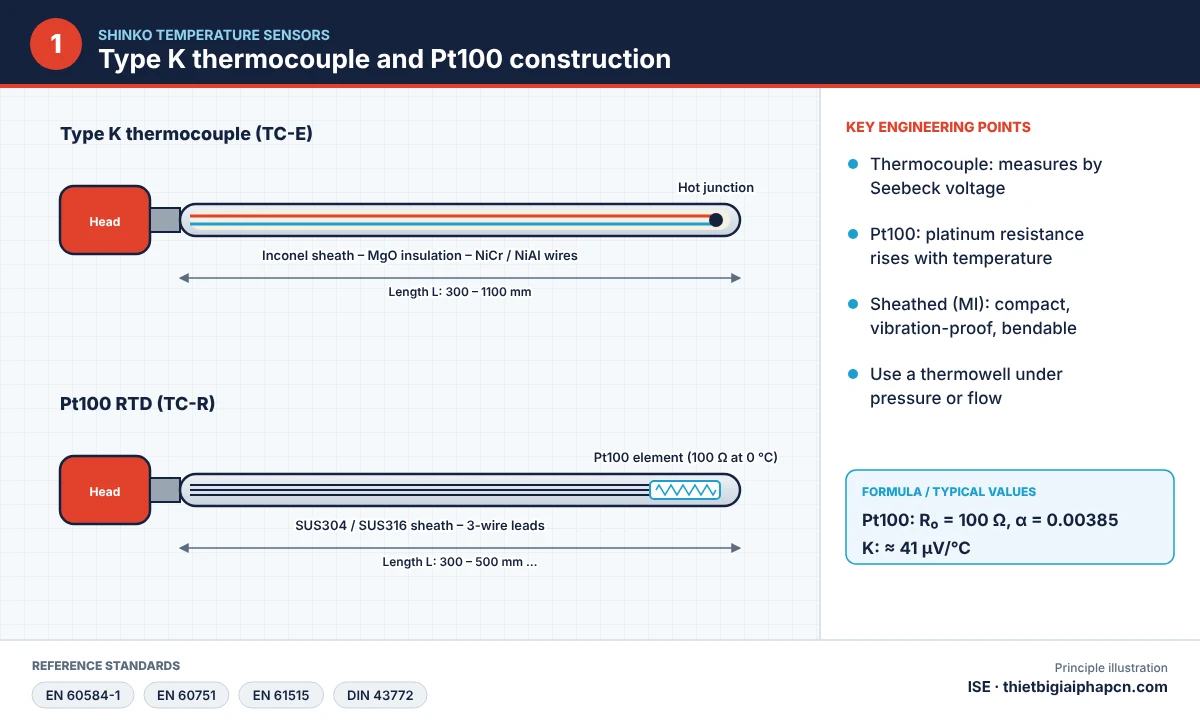
Shinko type K thermocouple (TC-E)

| Parameter | Value |
|---|---|
| Model | TC-E |
| Element | SK – mineral-insulated (sheathed) type K thermocouple |
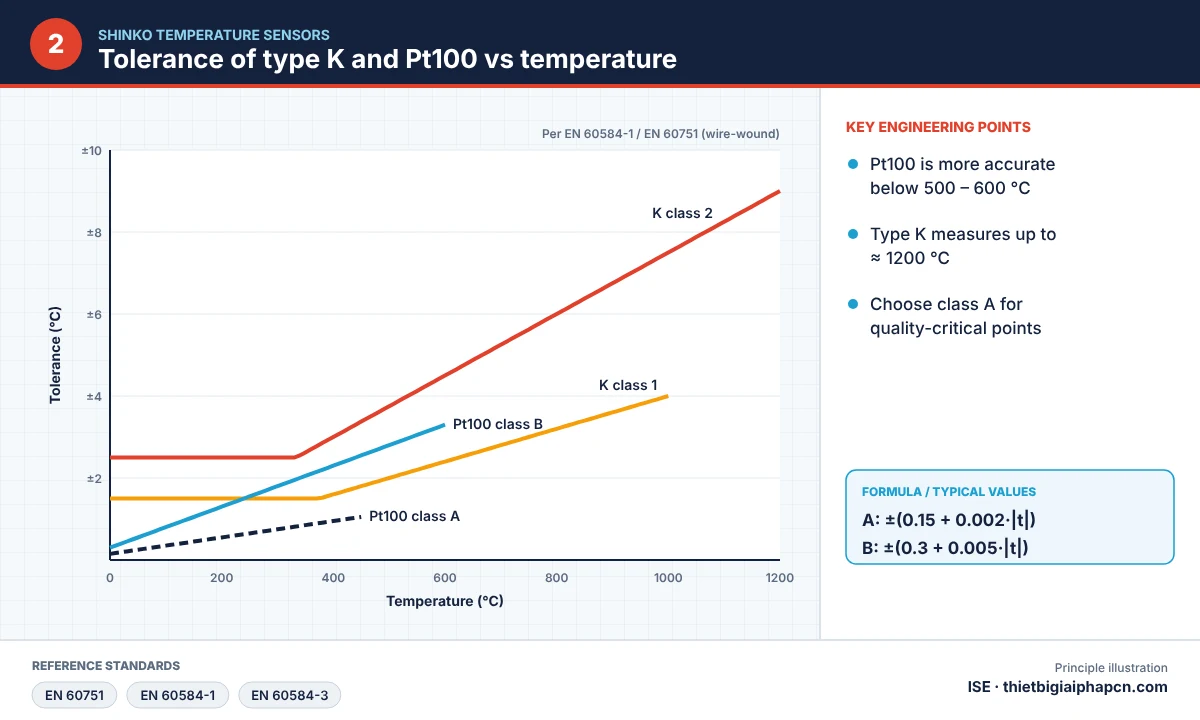
| Accuracy | Class 2 per EN 60584-1: ±2.5 °C or ±0.0075·|t| (−40 … 1,200 °C) |
| Sheath material | Inconel |
| Sheath diameter | Φ8, Φ10, Φ12, Φ16 mm… |
| Length L | 300, 500, 700, 800, 1,100 mm… |
| Temperature | Up to about 1,200 °C (depends on sheath, diameter and atmosphere) |
Shinko Pt100 RTD (TC-R)

| Parameter | Value |
|---|---|
| Model | TC-R |
| Element | Pt100 (100 Ω at 0 °C, α = 0.00385) |
| Accuracy | Class A: ±(0.15 + 0.002·|t|) °C; class B: ±(0.3 + 0.005·|t|) °C per EN 60751 |
| Sheath material | SUS304, SUS316 |
| Sheath diameter | Φ8, Φ10, Φ12 mm… |
| Length | 300, 400, 500 mm… |
| Wiring | 3-wire (2 or 4-wire on request) |
Type K thermocouple or Pt100?
| Criterion | Type K | Pt100 |
|---|---|---|
| Principle | Seebeck voltage at the junction | Platinum resistance changes with temperature |
| Range | Up to about 1,200 °C | Typically −50 … 500 °C |
| Accuracy | Lower (±2.5 °C class 2) | High (±0.35 °C at 100 °C, class A) |
| Robustness | High temperature, vibration-resistant | Long-term stable, avoid shocks |
| Applications | Furnaces, kilns, dryers, flue gas, burners | Steam, hot oil, food, HVAC |
Pt100 tolerance by class (JUMO – Pt100 accuracy class): class A ±0.15 °C at 0 °C and ±0.35 °C at 100 °C; class B ±0.3 °C at 0 °C and ±0.8 °C at 100 °C.
Wiring temperature sensors correctly
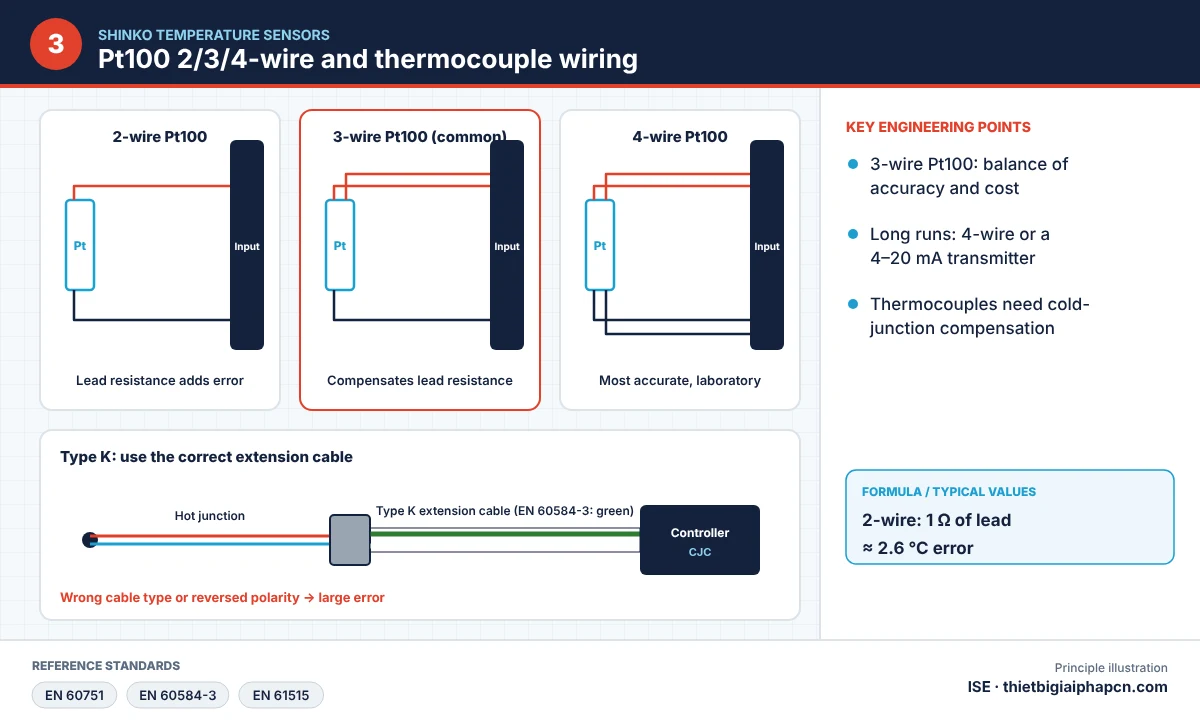
- 2-wire Pt100: lead resistance adds to the reading – 1 Ω of lead gives about 2.6 °C error.
- 3-wire Pt100: compensates lead resistance; the industrial standard choice.
- 4-wire Pt100: most accurate; or use a 4–20 mA head transmitter for long cable runs.
- Type K: use the correct type K extension cable (EN 60584-3, green), correct polarity, and cold-junction compensation at the instrument.
EU standards
| Standard | Scope |
|---|---|
| EN 60584-1 | Thermocouple EMF tables and tolerances |
| EN 60584-3 | Extension and compensating cables, colour code |
| EN 60751 | Platinum RTDs (Pt100), tolerance classes |
| EN 61515 | Mineral-insulated cables and thermocouples |
| DIN 43772 | Thermowells for sensor protection |
Applications of Shinko temperature sensors
- Furnaces, dryers, heat treatment, combustion chambers, boiler flue gas.
- Steam lines – see the saturated steam temperature table – and thermal oil.
- Plastic injection, moulds, food processing, HVAC.
FAQ
Can Shinko sensors replace other brands?
Yes, if element type (K or Pt100), accuracy class, dimensions and connections match. ISE helps cross-check specifications.
Why does a type K thermocouple drift at high temperature?
Ageing, EMF drift and sheath oxidation. Check and calibrate periodically and select an Inconel sheath of suitable diameter for the working temperature.
Related products
Buy Shinko temperature sensors from ISE
EQUIPMENT INDUSTRIAL SOLUTION CO., LTD (ISE) – Ho Chi Minh City, Vietnam.
Contact us: Sales +84 909 617 185 – Technical +84 979 117 185 – Email: [email protected]


