
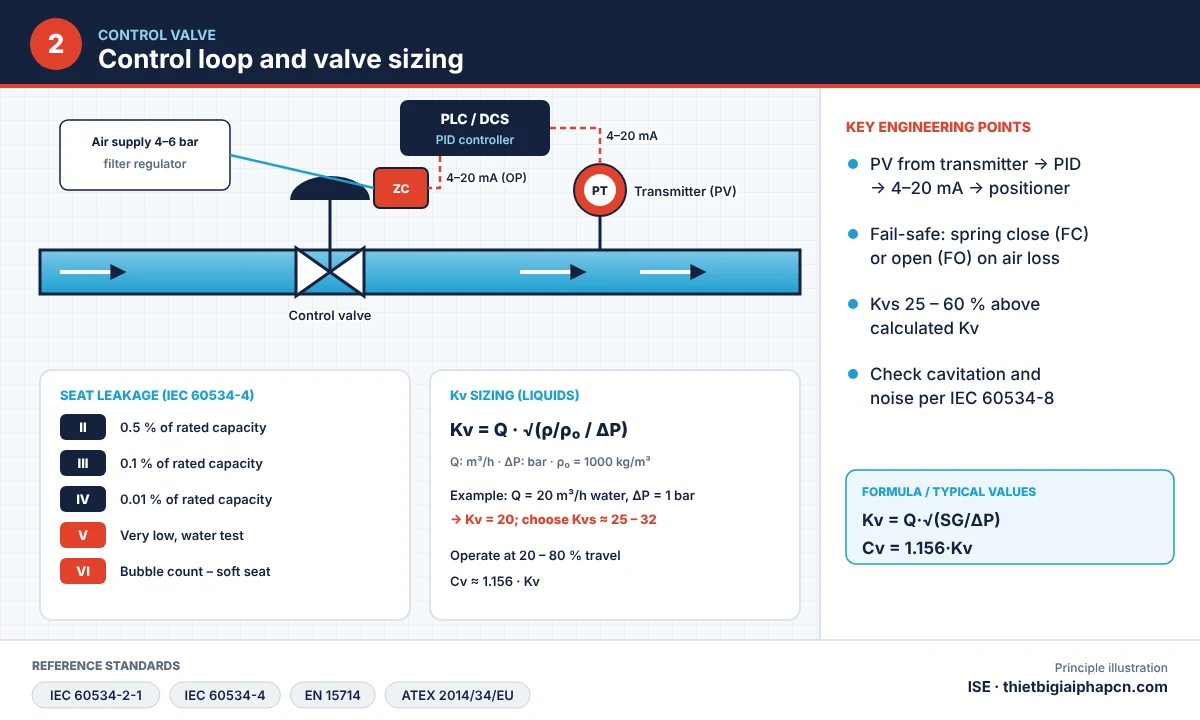
A control valve is the final element of a control loop: it receives a 4–20 mA signal from the PLC/DCS and changes its opening to hold pressure, temperature, flow or level at setpoint. ISE supplies globe, angle, V-port ball and butterfly control valves with pneumatic or electric actuators and HART positioners for boilers, thermal oil, steam, water and chemicals, designed to the EN 60534 (IEC 60534) series and the Pressure Equipment Directive 2014/68/EU.

Control valve construction
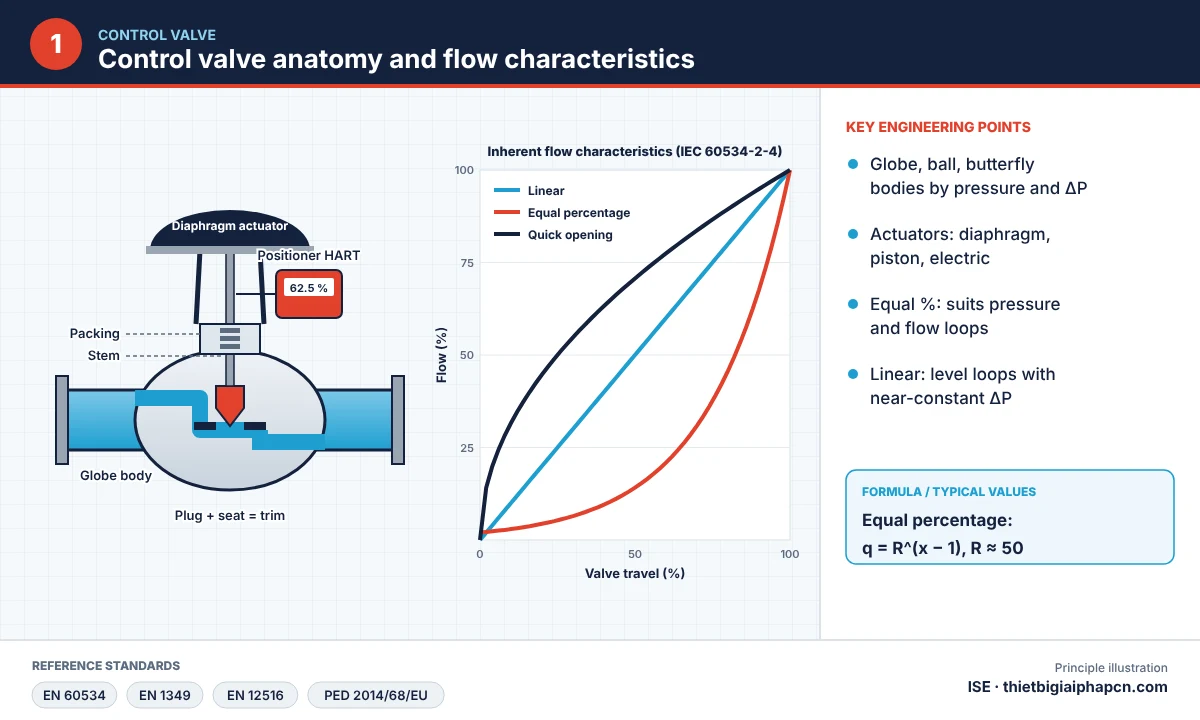
A control valve has four parts: the body (pressure boundary and pipe connection), the trim (plug and seat, which set the characteristic and leakage class), the actuator (diaphragm, piston or electric) and the positioner (compares the 4–20 mA signal with stem position for accurate positioning).
Control valve types
| Type | Advantage | Application |
|---|---|---|
| Globe | Precise control, high ΔP | Steam, boiler feedwater, thermal oil |
| Angle | Dirty media, flashing, cavitation | Blowdown, condensate |
| V-port ball | Wide rangeability, clog-resistant | Pulp, slurry, fibrous liquids |
| Butterfly | Large lines, low ΔP, low cost | Combustion air, cooling water |
| 3-way | Mixing or diverting | Oil and water temperature control |
Control valve flow characteristics
Equal percentage: each increment of travel changes flow by the same percentage – suits most pressure, flow and temperature loops because valve ΔP varies with load. Linear: flow proportional to travel – suits level loops with near-constant ΔP. Quick opening: on/off and process safety duty.
Control valve specifications
| Parameter | Value |
|---|---|
| Size | DN15 – DN600 (1/2″ – 24″) |
| Rating | ASME Class 150 – 2500, PN to EN 1092-1, JIS |
| Ends | Flanged, butt-weld, screwed |
| Body material | Carbon steel, Cr-Mo, stainless, duplex, Monel, Hastelloy B/C, aluminium bronze |
| Bonnet | Standard to 400 °C; finned; extended for cold and cryogenic service; bellows seal |
| Packing | PTFE chevron, graphite, low-emission |
| Trim | Top-guided, balanced / unbalanced cage, micro-flow, multi-stage low-noise |
| Trim material | Stainless, 13 % Cr, duplex, Monel, Hastelloy, Stellite overlay |
| Characteristic | Equal percentage, linear, quick opening |
| Seat leakage | Class III, IV, V, VI per IEC 60534-4 / ANSI FCI 70-2 |
| Actuator | Diaphragm, piston, electric; direct / reverse, FC / FO |
| Accessories | I/P and smart HART positioners, filter regulator, solenoid, volume booster, airlock, limit switches, handwheel |
Control valve sizing by Kv
Kv is the water flow (m³/h) through the fully open valve at ΔP = 1 bar. For liquids: Kv = Q · √(ρ/ρ₀ / ΔP); choose a Kvs 25–60 % above the calculated Kv so the valve operates at 20–80 % travel. For steam, gas, cavitation, flashing and noise, use the full IEC 60534-2-1 and IEC 60534-8 methods.
Control valve applications in boilers
- Drum level control with the feedwater valve.
- Steam pressure reduction and stabilisation for process users.
- Thermal oil temperature control with 3-way valves.
- Air and fuel trim based on flue gas O₂.
Measurement signals come from pressure transmitters, temperature sensors and flow meters.
European standards for control valves
| Standard | Scope |
|---|---|
| EN 60534 (IEC 60534) | Industrial-process control valves: sizing (-2-1), characteristics (-2-4), leakage (-4), noise (-8) |
| EN 1349 | Industrial process control valves – general requirements |
| EN 12516-1/-2 | Industrial valve shell strength |
| EN 1092-1 | PN flanges |
| EN 15714 | Industrial valve actuators |
| 2014/68/EU (PED) | Pressure equipment |
| 2014/34/EU (ATEX) | Positioners and solenoids in explosive atmospheres |
Control valve FAQ
Fail-close or fail-open?
Choose the safe state on air or power loss: fuel and steam valves usually fail closed (FC); boiler feedwater and cooling water valves usually fail open (FO).
Why does a control valve hunt?
An oversized valve throttling near the seat, high packing friction, an untuned positioner or unsuitable PID settings. Check Kv and run the positioner auto-tune.
How often should control valves be serviced?
Check packing leaks, stroke and air supply monthly; replace packing and inspect trim at the annual boiler shutdown.
Contact EQUIPMENT INDUSTRIAL SOLUTION CO., LTD (ISE) – Sales +84 909 617 185 – Technical +84 979 117 185 – [email protected] for control valve selection.


