
An autoclave temperature sensor is a flexible-cable Pt100 probe placed directly in the load or chamber to measure and validate steam sterilisation cycles. The cable is rated to 5 bar and 200 °C, with a measuring range of −96 … 300 °C; the sensing element is made in Germany and finished in Vietnam. It suits European practice under EN 285, EN 13060 and EN ISO 17665-1.

Autoclave temperature sensor specifications
| Parameter | Value |
|---|---|
| Element | Pt100 (class A or B per EN 60751) |
| Range | −96 … 300 °C |
| Cable | Flexible, pressure-rated 5 bar, cable up to 200 °C |
| Connection | Pressure-tight gland; Pt100 or 4–20 mA output |
| Origin | German element, assembled in Vietnam |
Why measure temperature in the load?
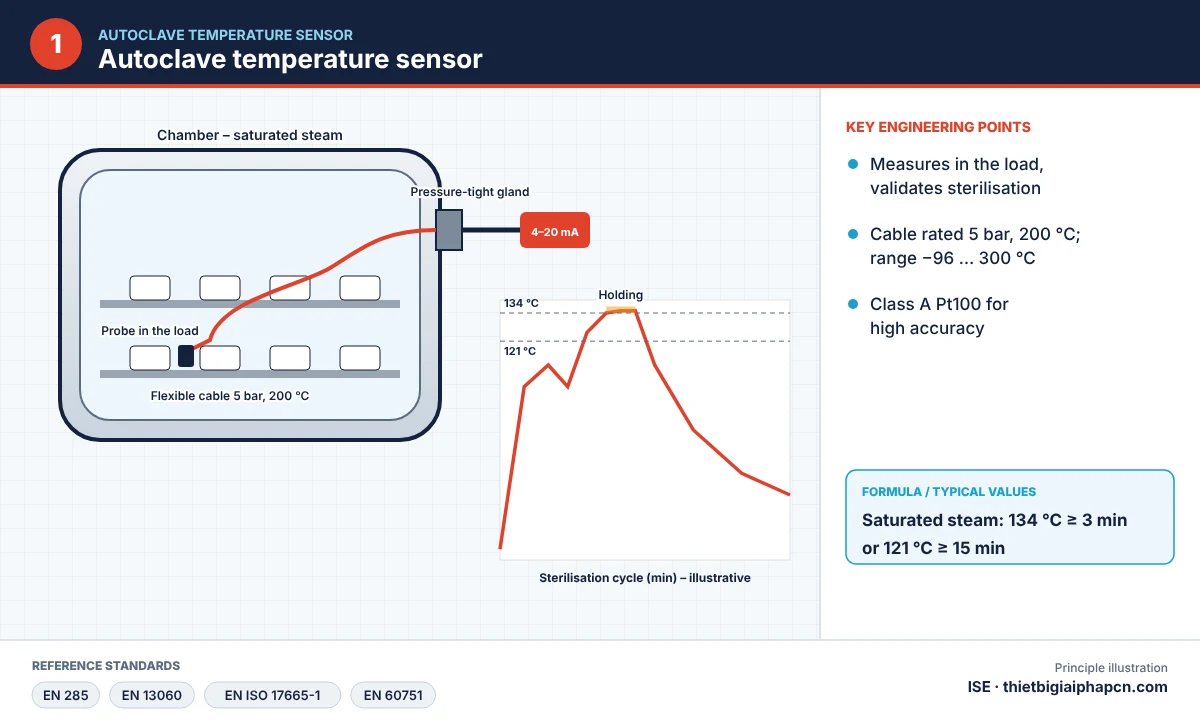
Chamber drain temperature does not show the temperature inside packs, bottles or wrapped goods. An autoclave temperature sensor in the load confirms temperature and holding time. For saturated steam, common reference cycles are 134 °C held for at least 3 minutes or 121 °C for at least 15 minutes (actual parameters per the validated process).
Applications
- Medical, laboratory and pharmaceutical sterilisers.
- Retorts for canned food and beverages.
- Industrial autoclaves: rubber, composites, safety glass.
Reference standards
| Standard | Scope |
|---|---|
| EN 285 | Large steam sterilisers |
| EN 13060 | Small steam sterilisers |
| EN ISO 17665-1 | Moist heat sterilisation – validation and control |
| EN 60751 | Pt100 tolerance classes |
Related products
Contact ISE
EQUIPMENT INDUSTRIAL SOLUTION CO., LTD (ISE) – Ho Chi Minh City, Vietnam.
Contact us: Sales +84 909 617 185 – Technical +84 979 117 185 – Email: [email protected]


