

An automatic boiler TDS blowdown control system (surface blowdown control) continuously measures boiler water conductivity and automatically opens and closes the surface blowdown valve to keep total dissolved solids (TDS) below the boiler manufacturer’s limit. It comprises a temperature-compensated conductivity probe, the BK 5000-T TDS controller and an automatic blowdown valve – no recalibration when boiler pressure or temperature changes, with 4–20 mA and Modbus RTU outputs for PLC/SCADA.
Compared with manual blowdown, automatic TDS control prevents foaming and carryover, reduces scaling and saves water, chemicals and fuel by blowing down only what is needed. Equipment Industrial Solution Co., Ltd (ISE) supplies, installs, commissions and calibrates complete systems for fire-tube and water-tube boilers.
Why control boiler water TDS?
TDS (Total Dissolved Solids) is the amount of dissolved minerals, salts and metals in water (mg/L = ppm). As water evaporates these remain in the boiler, so concentration rises with steam production. When TDS exceeds the limit:
- Foaming and carryover – wet steam contaminating downstream equipment and products.
- Scale on heat-transfer surfaces – higher tube temperatures and fuel consumption.
- False level readings – foam disturbs gauge glasses and level probes.
- Corrosion and blockage of control valves, steam traps, headers and heat exchangers.
The remedy is surface blowdown: removing concentrated boiler water just below the surface and replacing it with lower-TDS feedwater. Too little blowdown causes problems; too much wastes heated, treated water, chemicals and fuel. Automatic TDS control holds TDS close to setpoint instead of swinging between manual blowdowns.
System components
| Component | Function | Typical data |
|---|---|---|
| 1. Conductivity probe (BD 5600-T) | Measures boiler water conductivity in situ, integrated temperature sensor for compensation | Stainless steel / PTFE insulation; PN40; up to approx. 32 bar g / 239 °C |
| 2. TDS controller (BK 5000-T) | Compares measurement with setpoint, controls valve, alarms | 230 VAC; valve relay + alarm relay; 4–20 mA (optional); Modbus RTU |
| 3. Automatic blowdown valve (BKV 5400) | Opens on high TDS, closes when conductivity falls below setpoint minus hysteresis | DN15–DN25, PN40; electric or pneumatic actuator |
| 4. Isolating valve | Isolates probe/valve assembly for maintenance | Same PN as boiler connection |
| 5. Check valve | Prevents back-flow from the blowdown header | PN40 |
| 6. Flow-regulating valve (optional) | Sets maximum blowdown flow | — |
| 7. Sample cooler (optional) | Cools boiler water sample to ≤ 25 °C for check measurements and calibration | Water-jacketed |
| 8. Flash vessel / heat recovery (optional) | Recovers flash steam and heat from blowdown | Sized to blowdown flow |
Two configurations: A – probe mounted directly in the boiler shell (below the lowest water level, continuous measurement); B – probe in a sample line (external chamber; the controller opens the valve periodically to purge and measure fresh boiler water).
How automatic TDS blowdown works
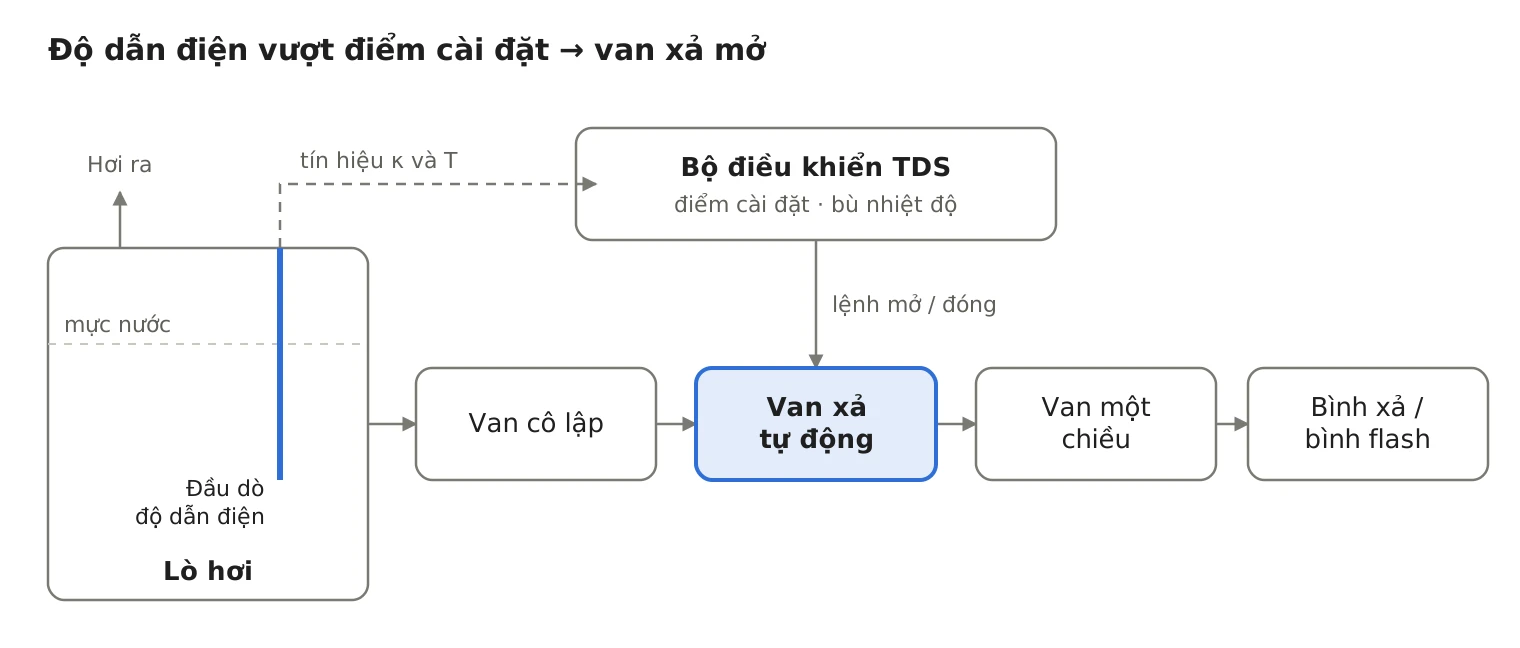
- The probe continuously measures conductivity; the temperature sensor signal is used to compensate to 25 °C.
- The controller compares the compensated value with the setpoint (µS/cm or ppm).
- Above setpoint → valve OPENS; concentrated water is discharged and replaced by feedwater.
- Below (setpoint − hysteresis) → valve CLOSES.
- MAX alarm when conductivity exceeds the high limit (fouled probe, failed valve, abnormal feedwater).
- MIN alarm when conductivity is abnormally low (valve stuck open, probe not immersed).
- Burner off / boiler standby → valve forced closed to avoid losing boiler water; monitoring and alarms remain active.
If a bottom blowdown valve shares the same blowdown header, the two valves must never open at the same time.
BK 5000-T TDS controller
The BK 5000-T measures boiler water conductivity and temperature via the BD 5600-T probe (integrated temperature sensor) and automatically compensates to 25 °C. It can also be used with the BD 5300-T probe; with the BD 5400 probe no temperature signal is available, so no compensation is applied.
| Parameter | Value |
|---|---|
| Conductivity range | 10–10,000 µS/cm (order ranges 10–2,000 or 100–10,000 µS/cm) |
| Temperature compensation | Automatic to 25 °C (with BD 5600-T) |
| Outputs | Blowdown valve relay (Relay 2), alarm relay (Relay 1) |
| Analogue output | 4–20 mA = 0–10,000 µS/cm (optional) |
| Communication | RS485 Modbus RTU – read value, setpoint, alarm limits; address 1–247; 1200–19200 baud |
| Power supply | 220/230 VAC, 50/60 Hz |
| Power consumption | 1 VA |
| Ingress protection | IP54 |
| Max. ambient temperature | 55 °C |
| Probe cable length | Max. 100 m (shielded 5 × 0.22–0.50 mm²) |
| Dimensions (H × D × W) | 72 × 110 × 144 mm, panel mounting |
| Weight | 0.5 kg |
| Standards | EMC 2014/30/EU; LVD 2014/35/EU (EN 61010-1) |
Settings: conductivity setpoint (e.g. 5,000 µS) and hysteresis (4–5 % of setpoint recommended); alarm limit and alarm hysteresis; calibration against boiler water sample; valve relay test (opens 15 s) and alarm relay test; water temperature and probe data display; password protection; Modbus settings.
Boiler TDS blowdown system specifications
| Parameter | Value |
|---|---|
| Range | 0.5–10,000 µS/cm (controller dependent); display µS/cm or ppm |
| Reference / compensation | 25 °C; automatic, approx. 2 %/°C |
| Setpoint / hysteresis | Adjustable |
| Alarms | MIN, MAX, probe or cable fault |
| Power supply | 24 VDC or 230 VAC, 50/60 Hz (configuration dependent) |
| Probe max. pressure / temperature | Up to approx. 32 bar g / 239 °C, model dependent |
| Probe connection | ½”–¾” BSP/NPT thread or EN 1092-1 flange |
| Probe insertion length | 300 / 500 / 1,000 mm (to suit boiler) |
| Blowdown valve | DN15, DN20, DN25 – PN40; electric 24 V / 230 VAC or pneumatic actuator |
Binding values are those on the datasheet and nameplate of the equipment supplied for each project.
Boiler water TDS limits to EN 12953-10
| Boiler water (at 25 °C) | Feedwater > 30 µS/cm (softened) | Feedwater ≤ 30 µS/cm (demineralised, RO) |
|---|---|---|
| Direct conductivity, µS/cm | ≤ 6,000 up to 20 bar; lower above 20 bar | < 1,500 |
| pH | 10.5–12.0 | 10.5–11.8 |
| Appearance | Clear, no stable foam | Clear, no stable foam |
Typical setpoints: boiler water 2,000–3,500 ppm TDS (about 3,000–5,000 µS/cm at 25 °C), always below the standard limit and the boiler manufacturer’s recommendation.
Blowdown calculation
Conductivity to TDS: TDS (ppm) = k × conductivity (µS/cm), with k about 0.5–0.7 depending on water composition – i.e. 1 µS/cm ≈ 0.5–0.7 ppm. Determine k on site by comparing laboratory TDS with conductivity of a cooled sample.
| TDS (ppm) | µS/cm at k = 0.5 | µS/cm at k = 0.7 |
|---|---|---|
| 1,000 | 2,000 | 1,429 |
| 2,000 | 4,000 | 2,857 |
| 3,000 | 6,000 | 4,286 |
| 3,500 | 7,000 | 5,000 |
Why temperature compensation matters: conductivity rises about 2 % per °C. Boiler water of 5,000 µS/cm (25 °C) at 10 bar g (≈ 184 °C) reads about 20,900 µS/cm – without compensation the error is about 4× and drifts with boiler pressure.
Required blowdown rate: blowdown = steam output × F / (B − F), where F = feedwater TDS and B = boiler water TDS setpoint.
Example: 10 t/h boiler, feedwater 250 ppm, boiler water held at 2,500 ppm → blowdown 1,111 kg/h (11.1 % of steam output). At 10 bar g this water carries about 138 kW of heat – so excess blowdown is costly and a flash vessel / heat recovery is recommended.
Versus manual blowdown: if manual blowdown keeps average TDS at only 1,500 ppm for safety, the same boiler must blow down 2,000 kg/h – about 890 kg/h more water, chemicals and heat than automatic TDS control. Actual savings depend on site data.
Benefits of automatic TDS blowdown
- Higher boiler efficiency – TDS held at the optimum, less scale on heat-transfer surfaces.
- Water, chemical and fuel savings – blowdown only as needed.
- Longer equipment life – less carryover into valves, traps and heat exchangers.
- Automation – no manual blowdown rounds, supports reduced-supervision operation.
- Easy monitoring – live values, alarms and 4–20 mA / Modbus for PLC and SCADA.
Installation, commissioning and maintenance
- Probe: below the lowest permissible water level, away from tubes and shell; away from feedwater inlet and chemical dosing points; never share a connection with level controls or low-water limiters.
- Blowdown line: boiler → isolating valve → automatic blowdown valve → check valve → blowdown vessel / flash vessel; never discharge directly to an open drain.
- Electrical: shielded probe cable routed away from power cables; 1 A fast fuse for the controller supply; burner-run signal to close the valve when the boiler stops.
- Calibration: at working pressure, take a sample through the cooler, measure conductivity with a handheld meter and enter it in the controller.
| Frequency | Task |
|---|---|
| Daily | Check display, alarms and valve status |
| Weekly | Compare reading with cooled sample; recalibrate if deviation > 10 % |
| 6-monthly | Remove and clean scale/oil from the probe; check insulation; check valve tightness |
| Annually / boiler inspection | Full function test, back up settings, replace gaskets and seals |
Safety: never remove the probe or valve while the boiler is under pressure. The TDS controller is a control device; where regulations or unattended operation (24 h / 72 h) require a conductivity limiter, use type-tested equipment to EN 12953-9 / EN 12952-11.
FAQ
How does TDS (surface) blowdown differ from bottom blowdown?
TDS blowdown removes water just below the surface, where dissolved solids are most concentrated, to control TDS continuously. Bottom blowdown removes sludge and settled solids from the bottom of the boiler. They complement rather than replace each other.
Can automatic TDS control be retrofitted to an existing boiler?
Yes, if the boiler has a surface blowdown connection or a suitable connection for the probe. ISE surveys and proposes configuration A or B.
Can it connect to a PLC or SCADA?
Yes. The BK 5000-T offers optional 4–20 mA and RS485 Modbus RTU.
Related products and solutions
- Boiler TDS sensor – Gestra, ViRA
- Boiler oxygen trim control
- Boiler drum level measurement system
- CST-MLG magnetic level gauge
- Vortex steam flow meter
Reference: EN 12953-10 – Requirements for feedwater and boiler water quality (shell boilers).
Where to buy an automatic boiler TDS blowdown system?
EQUIPMENT INDUSTRIAL SOLUTION CO., LTD (ISE) – Ho Chi Minh City, Vietnam – supplies genuine an automatic boiler TDS blowdown system with technical consulting, fast quotation and on-site commissioning support across Vietnam and Southeast Asia.
Contact us: Sales +84 909 617 185 – Technical +84 979 117 185 – Email: [email protected]


