
Car park CO monitoring, together with NO₂ detection, protects drivers, attendants and property in underground car parks. Exhaust from cars, motorcycles and generators builds up quickly in enclosed spaces; gas sensors combined with exhaust fans controlled by concentration keep the air safe and save energy. ISE advises on, supplies and installs CO and NO₂ monitoring systems to the European standard EN 50545-1.
What are CO and NO₂?
- CO (carbon monoxide): colourless, odourless, tasteless, flammable and highly toxic; produced by incomplete combustion. In car parks it comes from vehicle exhaust, especially cold starts and queues.
- NO₂ (nitrogen dioxide): reddish-brown gas from engines, especially diesel; irritates the airways.
- NO (nitric oxide): also in exhaust, gradually oxidising to NO₂.
Health effects and exposure limits
| CO (ppm) | Typical symptoms |
|---|---|
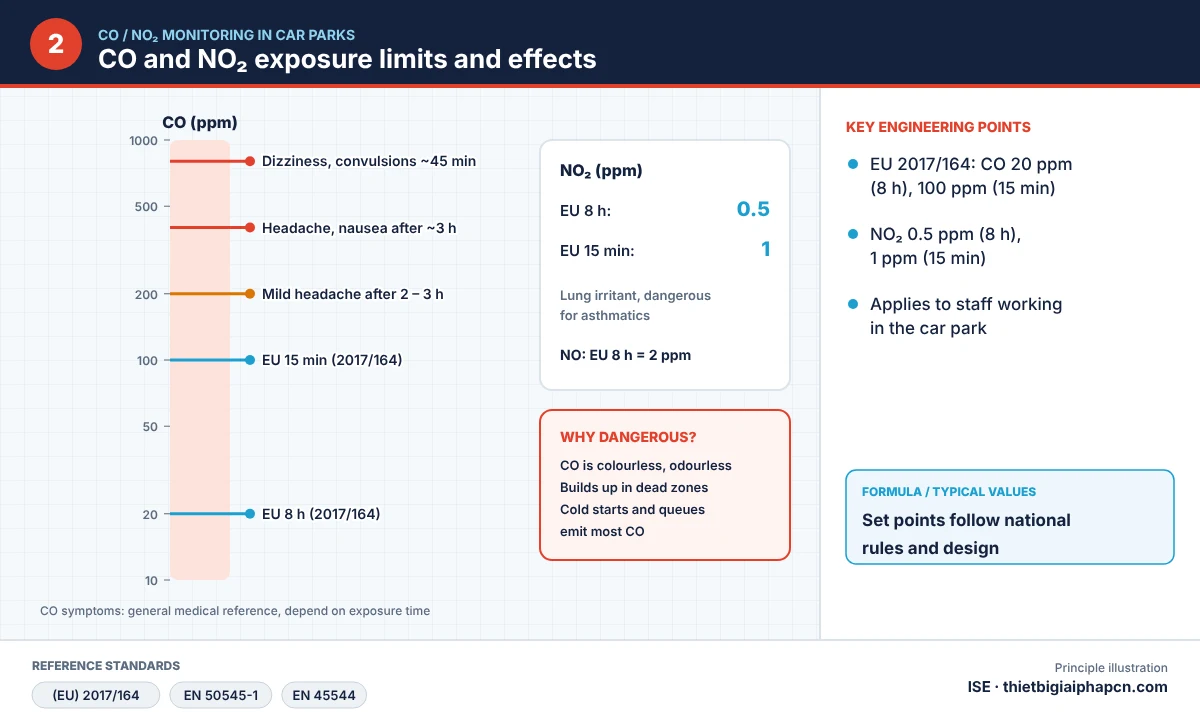
| 50 | No significant effects over 8 h (healthy adults) |
| 200 | Mild headache, nausea after 2 – 3 h |
| 400 | Headache, nausea, breathlessness after about 3 h |
| 800 | Dizziness, nausea, convulsions after 45 min; unconsciousness after 2 h, possibly fatal |
EU occupational exposure limits under Directive (EU) 2017/164:
| Gas | 8-hour TWA | 15-minute short-term |
|---|---|---|
| CO | 20 ppm (23 mg/m³) | 100 ppm (117 mg/m³) |
| NO₂ | 0.5 ppm (0.96 mg/m³) | 1 ppm (1.91 mg/m³) |
| NO | 2 ppm (2.5 mg/m³) | – |
How car park CO monitoring works
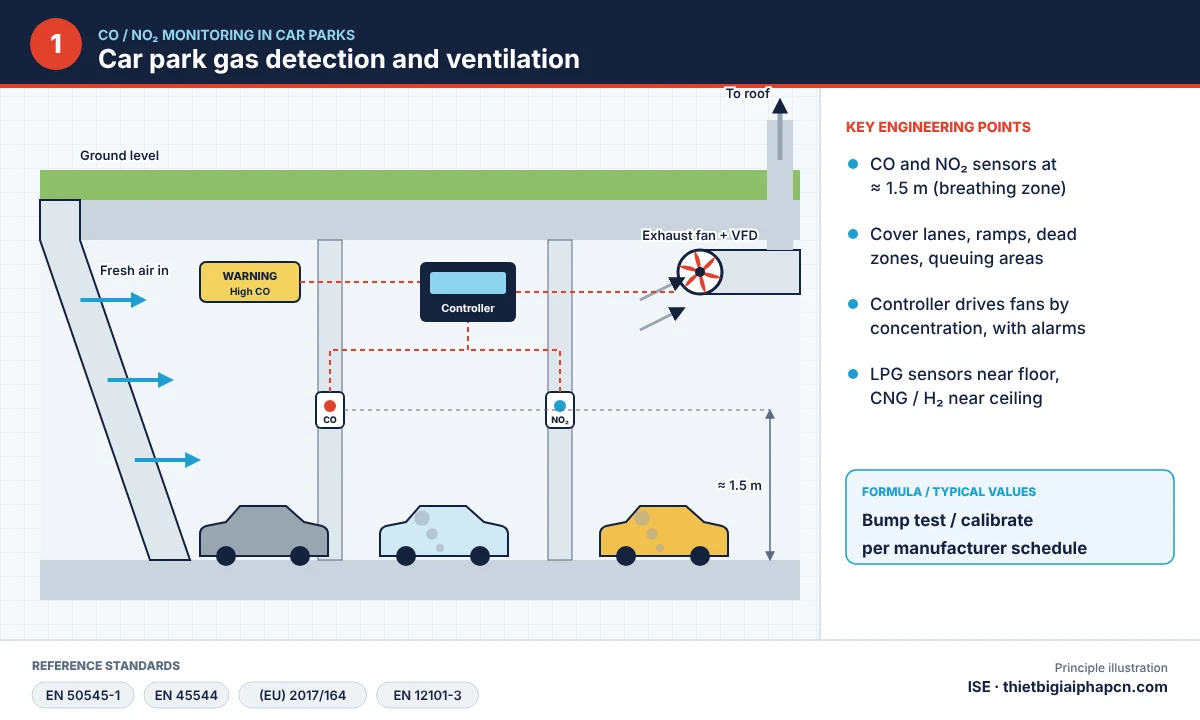
- CO and NO₂ sensors at about 1.5 m (breathing zone), covering lanes, ramps, dead zones and queuing areas; LPG sensors near the floor, CNG/H₂ near the ceiling.
- Control panel compares readings with thresholds, drives exhaust/supply fans, beacons and sirens, and links to the BMS via Modbus.
- Exhaust fans with VFDs follow gas concentration – see fan control with VFDs.
- Warning signs at entrances and stairwells when levels are exceeded.
Car park CO monitoring with demand-controlled ventilation
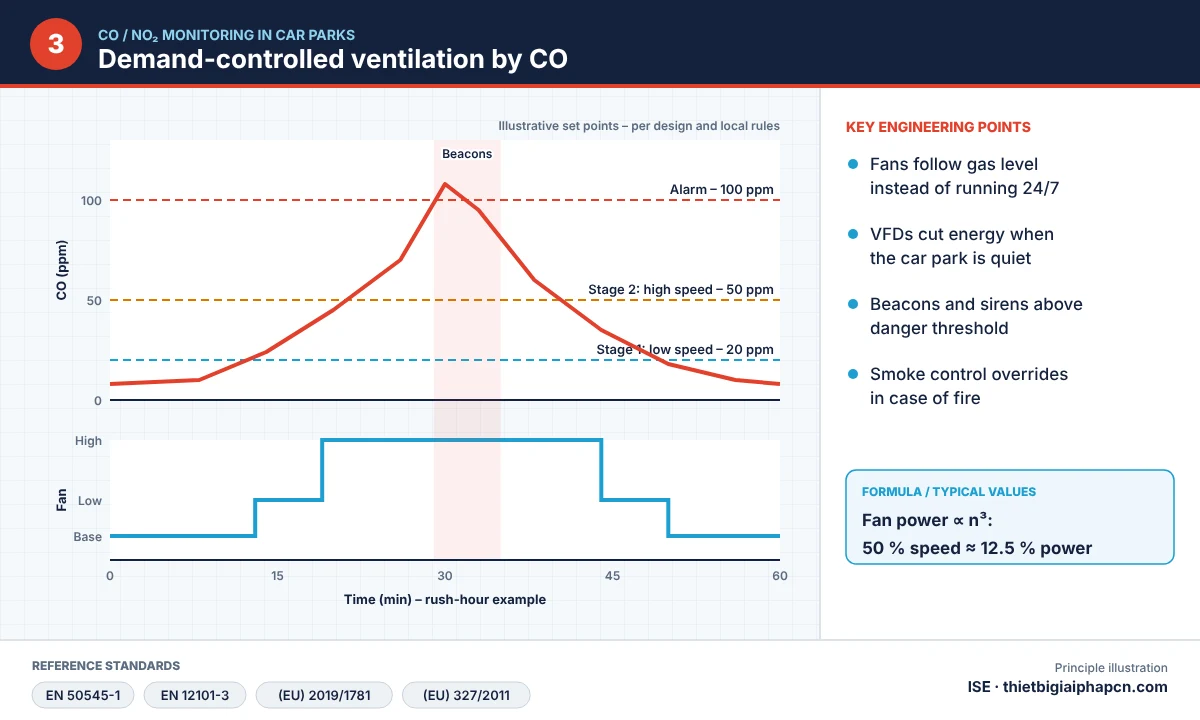
Instead of running fans continuously, the system follows gas concentration: low base speed when quiet, higher speed above stage 1, full speed at stage 2 and an alarm above the danger threshold. Since fan power varies with the cube of speed, 50 % speed uses only about 12.5 % of the power. Thresholds shown are examples; actual set points follow the design and local regulations. Smoke control always overrides in a fire.
EU standards for car park CO and NO₂ monitoring
| Standard | Scope |
|---|---|
| EN 50545-1 | Fixed apparatus for detecting and measuring CO, NO and NO₂ in car parks and tunnels: construction, testing, alarms, self-monitoring |
| EN 45544 | Workplace toxic gas measuring equipment |
| Directive (EU) 2017/164 | Occupational exposure limits for CO, NO, NO₂ |
| EN 12101-3 | Powered smoke and heat exhaust ventilators |
| Regulations (EU) 2019/1781, 327/2011 | Motor, drive and fan efficiency |
Benefits
- Early warning of dangerous CO and NO₂ levels, protecting health and life.
- Automatic ventilation control and monitoring; lower fan energy.
- Reduced incident risk, supporting smoke control and fire safety.
- Logged data and BMS integration for building management.
ISE car park CO monitoring services
- Survey the car park layout, traffic and existing fans.
- Lay out CO, NO₂ (and LPG if needed) sensors; design control panel and DCV logic.
- Supply sensors, controllers, VFDs, beacons and sirens.
- Installation, commissioning, calibration; maintenance and periodic gas testing.
FAQ
How many CO sensors does a car park need?
It depends on area, lane layout, ramps and dead zones; ISE calculates it from the floor plan and the sensor manufacturer’s guidance.
How often should sensors be calibrated?
Bump-test and calibrate periodically per the manufacturer; electrochemical sensors have a limited life and must be replaced when expired.
Related
- Flue gas analyzer CO, NO, SO₂
- Continuous emission monitoring system (CEMS)
- Differential pressure transmitter applications
Contact ISE about car park CO monitoring
EQUIPMENT INDUSTRIAL SOLUTION CO., LTD (ISE) – Ho Chi Minh City, Vietnam.
Contact us: Sales +84 909 617 185 – Technical +84 979 117 185 – Email: [email protected]


