
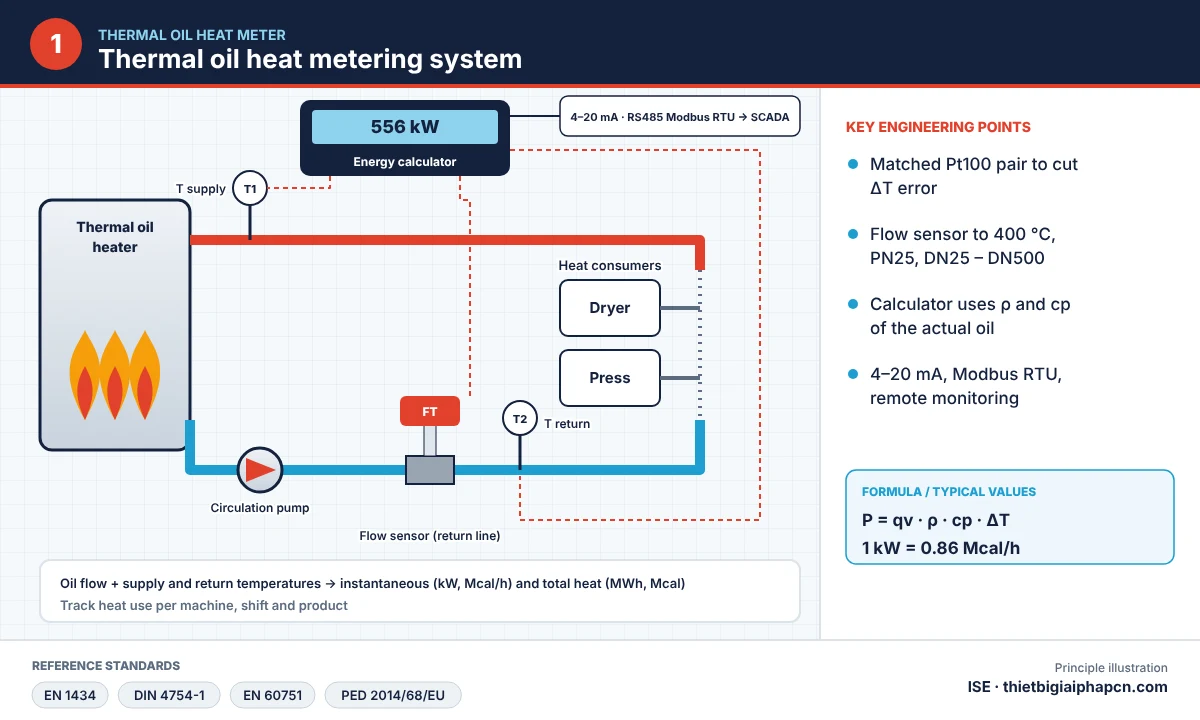
A thermal oil heat meter measures oil flow together with supply and return temperatures to calculate heat output (kW, Mcal/h) and total heat consumed (MWh, Mcal) by each dryer, press or cooker. You learn exactly how much heat each product uses, spot losses and optimise the heater in line with ISO 50001 energy management.

How a thermal oil heat meter works
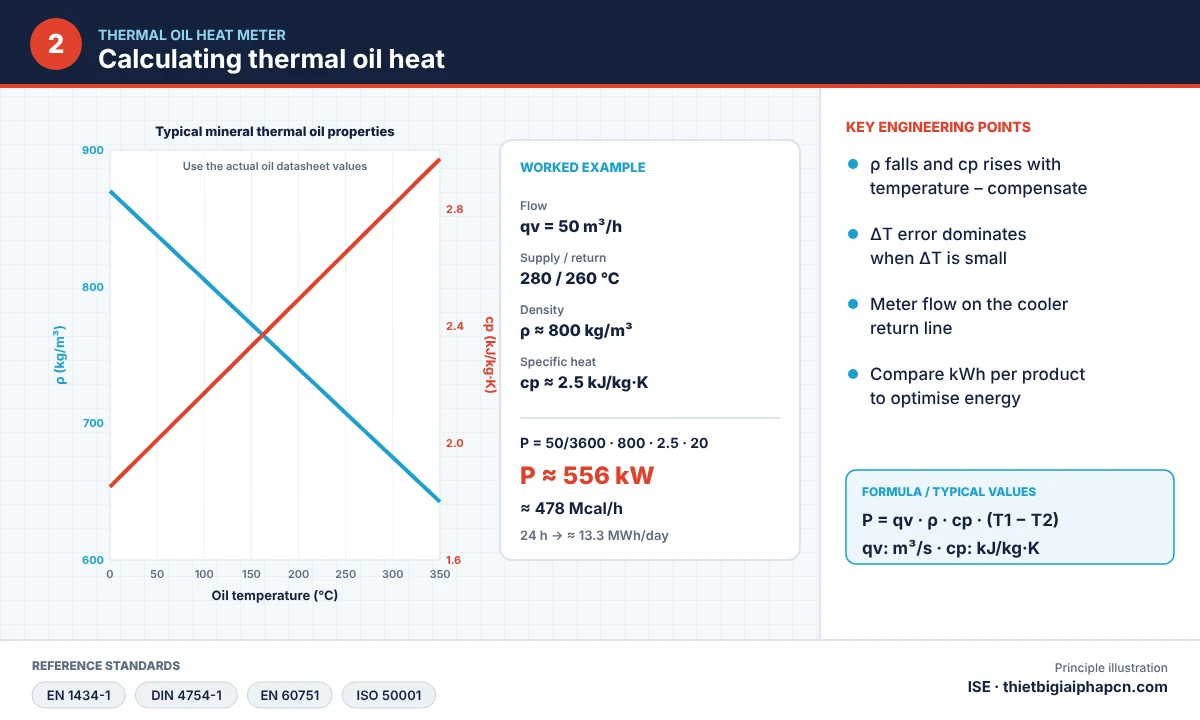
The energy calculator takes three inputs: oil volume flow qv, supply temperature T1 and return temperature T2 (a matched Pt100 pair). Heat output: P = qv · ρ · cp · (T1 − T2), where density ρ and specific heat cp are taken at actual temperature for the specific oil in use.
Specifications
| Parameter | Value |
|---|---|
| Size | DN25 – DN500 |
| Operating temperature | Up to 400 °C |
| Operating pressure | PN25 |
| Accuracy | ±1 % |
| Display | Oil flow (m³/h), supply and return temperature (°C), heat rate (Mcal/h), total heat (Mcal) |
| Outputs | 4–20 mA, Modbus RTU RS485 |
| Monitoring | Online by phone or PC: values, alarms, history |
Calculating thermal oil heat
Example: 50 m³/h oil, 280 °C supply, 260 °C return, ρ ≈ 800 kg/m³, cp ≈ 2.5 kJ/kg·K → P ≈ 556 kW ≈ 478 Mcal/h, about 13.3 MWh per day in continuous operation. Because ΔT is often only 15–30 K, temperature error dominates: use a matched class A Pt100 pair per EN 60751 in correctly sized thermowells.
Installation
- Fit the flow sensor on the cooler return line with the straight runs the manufacturer specifies.
- T1 on supply, T2 on return, close to the consumer; insulate the sensor points.
- Load the correct ρ and cp tables for the oil into the calculator.
- Design and operate the thermal oil system to DIN 4754-1; pressure parts must comply with PED 2014/68/EU.
Applications
Heat delivered to dryers, wood presses, cookers, textile dyeing machines and bitumen tanks; energy cost allocation by workshop; heater efficiency checks together with our temperature sensors. For steam, use a vortex steam flow meter with P/T compensation.
Reference standards
| Standard | Scope |
|---|---|
| EN 1434-1…-6 | Heat meters – calculator principle and paired temperature sensors (written for water; for oil the calculator uses oil properties) |
| EN 60751 | Pt100 temperature sensors |
| DIN 4754-1 | Heat transfer installations using organic fluids |
| 2014/68/EU (PED) | Pressure equipment |
| EN 61326-1 | Electromagnetic compatibility |
| ISO 50001 | Energy management systems |
FAQ
Can a water heat meter be used for oil?
No: water meters use water ρ and cp and are usually limited below 150 °C. Thermal oil needs a 300–400 °C flow sensor and a calculator loaded with oil properties.
How do Mcal/h and kW convert?
1 kW ≈ 0.86 Mcal/h; 1 Mcal/h ≈ 1.163 kW.
Contact EQUIPMENT INDUSTRIAL SOLUTION CO., LTD (ISE) – Sales +84 909 617 185 – Technical +84 979 117 185 – [email protected].


