
An air knife drying system produces a thin, high-velocity air curtain that blows water, dust, chips and oil off products moving on a conveyor – without contact, chemicals or heat. ISE advises on, designs and installs blower-driven air knife systems that meet European machinery safety, noise and food hygiene requirements.
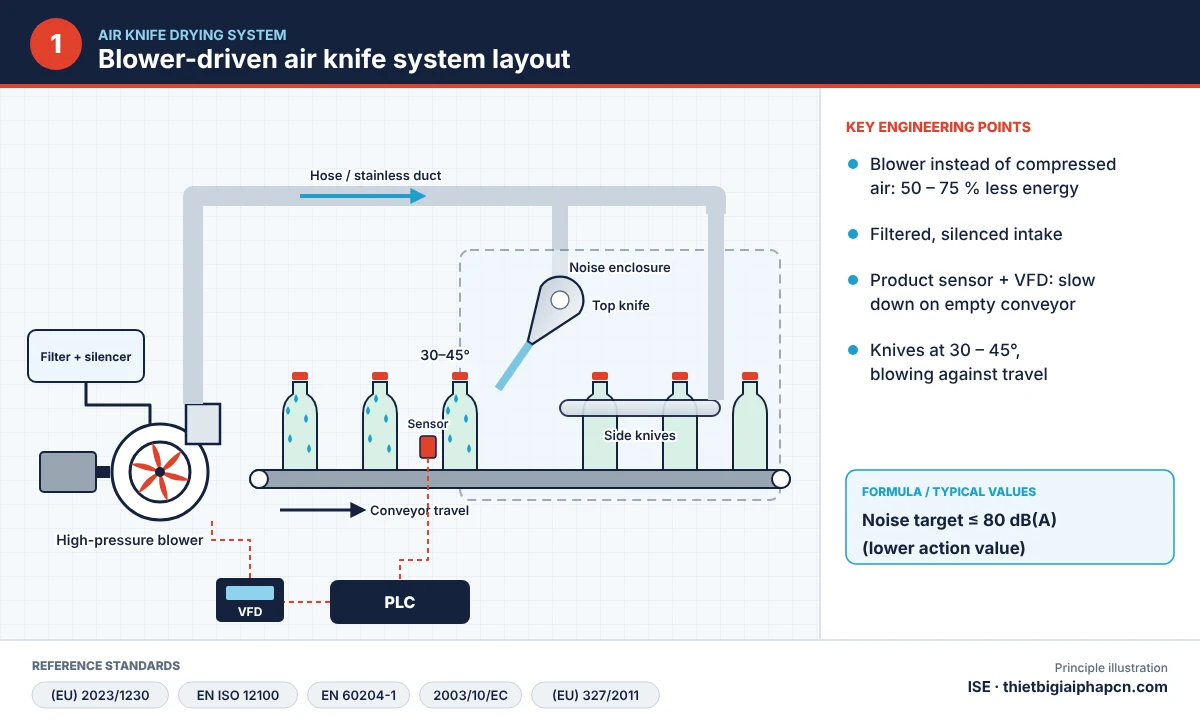
Main components of an air knife drying system
| Component | Function |
|---|---|
| Air knife | 304/316 stainless or aluminium body with a 0.1–2 mm slot along its length for an even curtain across the product width |
| Air source | High-pressure centrifugal blower (energy-efficient) or plant compressed air |
| Intake filter and silencer | Keeps blown air clean and reduces intake noise |
| Ducting and valves | Hose or stainless duct, flow damper; for compressed air: filter, regulator, solenoid valve |
| Adjustable mounting | Sets knife angle and distance; fixed or movable |
| Blow-off enclosure | Reduces noise, captures water and mist, protects operators |
| Controls | Blower VFD, product-presence sensor, PLC; differential pressure sensor for filter alarm |
How an air knife drying system works
Air enters the knife plenum and leaves through the slot as a flat, uniform curtain. Depending on design, impact velocity ranges from a gentle breeze to above Mach 0.6. The curtain:
- Strips water, dust, chips and oil from surfaces.
- Dries products after rinsing, pasteurising or cooling.
- Separates two zones as an air curtain.
Knives are typically set at around 30–45° blowing against conveyor travel, a few tens of millimetres from the product; bottles and cans also need side and bottom knives.
Blower or compressed-air air knife?
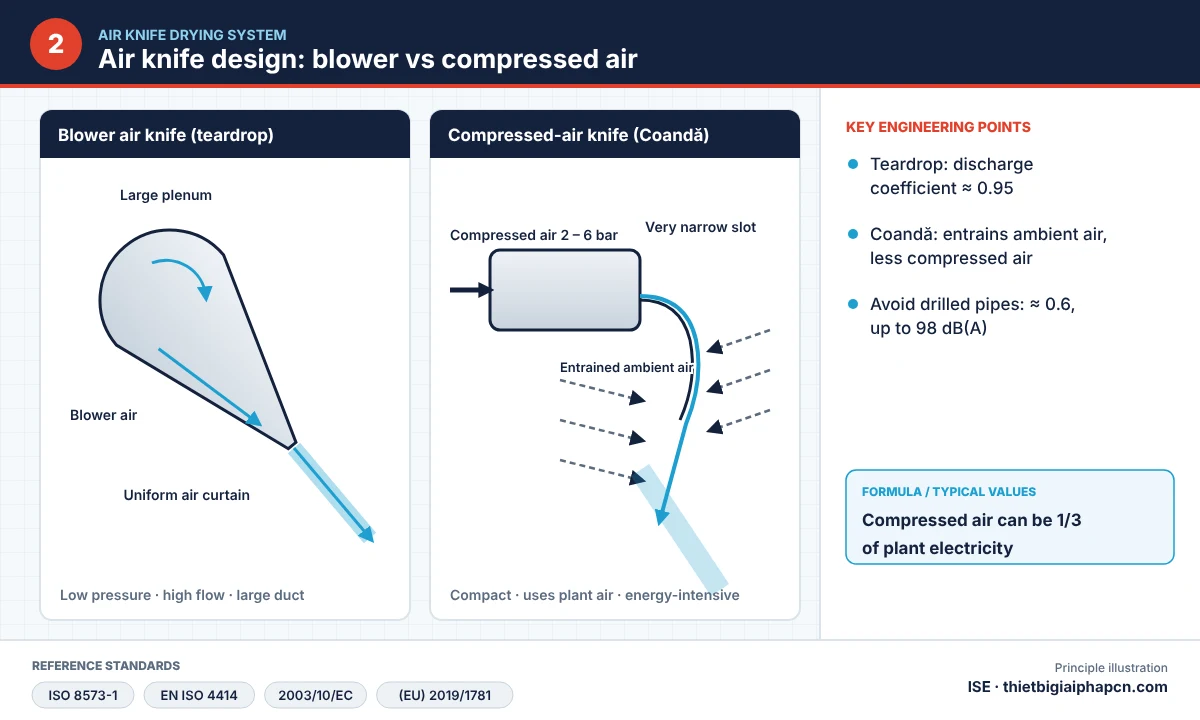
| Criterion | Blower air knife | Compressed-air knife |
|---|---|---|
| Air source | High-pressure blower | Compressed air 2–6 bar |
| Energy | 50–75 % less than compressed-air knives | High: compressed air can be up to 1/3 of plant electricity |
| Size | Larger knife and supply duct | Compact, small supply line |
| Noise | Low with silencer and enclosure | High with drilled pipes (up to 98 dB(A) at 7 bar) |
| Best for | Continuous, wide lines | Tight spaces, intermittent use, spare plant air |
Reference figures: blower knives use 50–75 % less energy than compressed-air knives; drilled pipes have a discharge coefficient of about 0.6 versus about 0.95 for teardrop knives (Wikipedia – Air knife); compressed air can account for up to 1/3 of plant electricity, and low-flow air knives use about 92 % less air than drilled pipes (Spraying Systems).
Typical applications
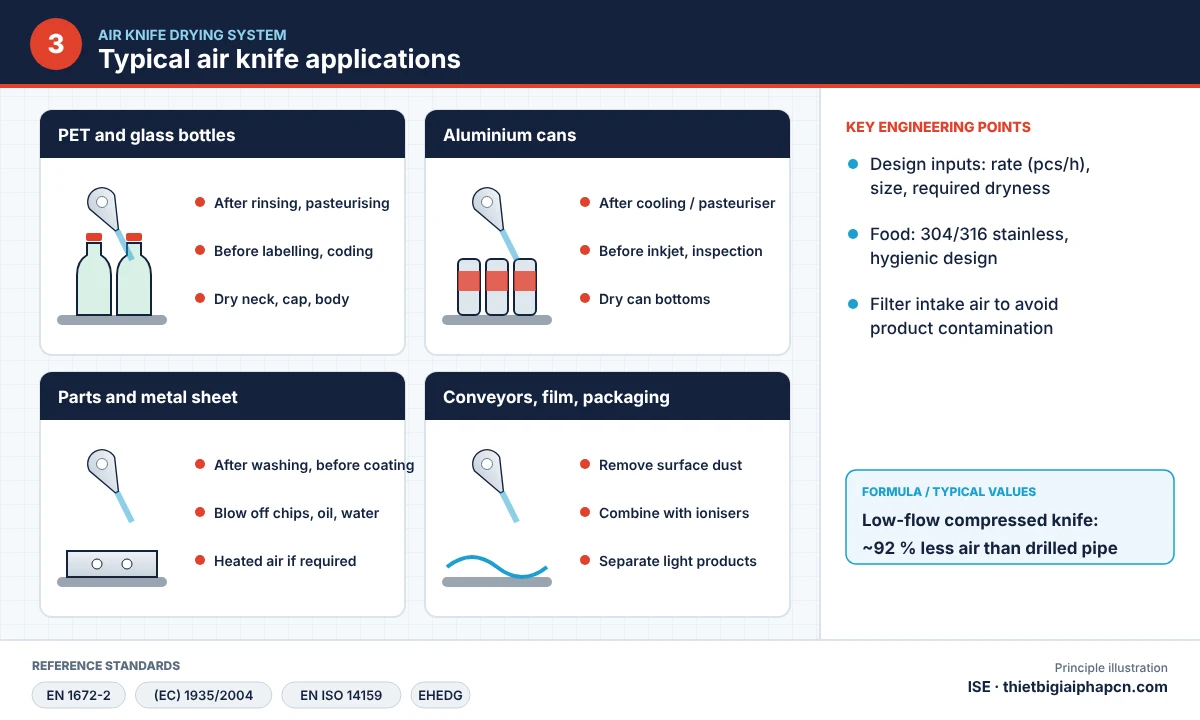
- PET and glass bottles: drying after rinsing or pasteurising, before labelling and coding.
- Aluminium cans: drying can bottoms after cooling, before inkjet coding and inspection.
- Parts and metal sheet: blowing off water, oil and chips after washing, before coating or packing.
- Conveyors, film, packaging: dust removal, combined with ionisers.
EU standards for air knife systems
| Standard | Scope |
|---|---|
| Machinery Directive 2006/42/EC → Regulation (EU) 2023/1230 | Machine safety; the new regulation applies from 20 January 2027 |
| EN ISO 12100 | Risk assessment and risk reduction |
| EN 60204-1 | Electrical equipment of machines |
| Directive 2003/10/EC | Workplace noise: action values 80 / 85 dB(A), limit 87 dB(A) |
| Regulations (EU) 327/2011, (EU) 2019/1781 | Fan efficiency; IE3/IE4 motors, IE2 drives |
| ISO 8573-1, EN ISO 4414 | Compressed air quality; pneumatic safety |
| EN 1672-2, EN ISO 14159, (EC) 1935/2004 | Hygienic design and food-contact materials |
Advantages of air knife drying
- Fast, even, contact-free drying without chemicals.
- Lower energy than compressed air, especially with VFD fan control.
- Better label adhesion and print quality, fewer inspection rejects and can-bottom corrosion.
- Easy retrofit to existing lines, simple maintenance.
How ISE designs an air knife system
- Survey product, line rate (pcs/h), size, required dryness and space.
- Calculate airflow and pressure; select blower, number and position of knives.
- Design enclosure, intake filter, silencer and stainless frame.
- Install and integrate VFD, sensors and PLC; measure noise and tune angles.
- Hand over documentation, train operators and maintenance staff.
FAQ
Does an air knife dry completely?
It removes most surface water; dryness depends on line speed, product shape, number of knives and angle. Heated air can be added where full dryness is needed.
Is an enclosure needed?
Recommended: it reduces operator noise exposure under 2003/10/EC, captures water and prevents mist on nearby equipment.
Related
Contact ISE about air knife systems
EQUIPMENT INDUSTRIAL SOLUTION CO., LTD (ISE) – Ho Chi Minh City, Vietnam.
Contact us: Sales +84 909 617 185 – Technical +84 979 117 185 – Email: [email protected]


