

ISE’s cement kiln oxygen measurement solution is a continuous O₂ and CO analysis system at the rotary kiln inlet, helping cement plants run the kiln steadily at optimum excess air, reduce fuel consumption and emissions, and meet European monitoring requirements (BAT 2013/163/EU, EN 14181). The sampling probe withstands up to 1,400 °C, samples process gas continuously at up to 1,200 °C, and sends 4–20 mA / Modbus signals directly to the DCS/PLC.
Why measure oxygen in a cement kiln?
In a clinker kiln, the combustion air supply determines combustion efficiency:
| Too little air | Too much air |
|---|---|
| Incomplete combustion, CO formation | Excess air carries heat up the stack |
| Risk of electrostatic precipitator CO trips | Higher fuel consumption |
| Variable clinker quality | Additional thermal NOx |
Continuous O₂ and CO measurement at the kiln inlet lets the DCS/PLC adjust the ID fan, coal / alternative fuel (RDF) feed and raw-meal feed in real time.
The engineering challenge at the kiln inlet: gas temperatures around 1,400 °C, dust loads up to 2,000 g/m³, plus alkali, chlorine and sulphur vapours that cause build-up and corrosion. Standard sensors cannot survive – a dedicated high-temperature gas sampling probe is required.
Measuring principle and control loop
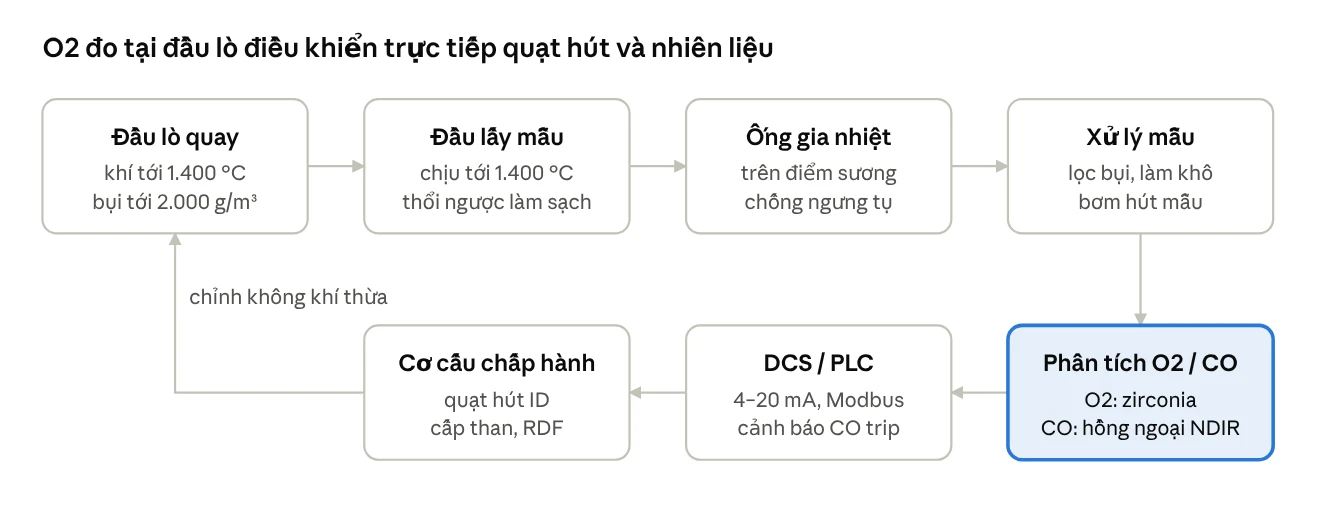
Gas is drawn continuously from the kiln inlet through a heat-resistant probe, heated sample line (preventing condensation) and sample conditioning (dust filtering, drying) to the analyser; the O₂/CO signals go to the DCS to adjust air and fuel.
- O₂ – zirconia (ZrO₂) electrochemical cell: above about 600 °C, zirconia ceramic conducts oxygen ions. The O₂ partial-pressure difference between sample gas and reference air produces a voltage according to the Nernst equation, converted to % O₂ by volume.
- CO – non-dispersive infrared (NDIR): fast response for early CO-trip warning.
Recommended measuring points
| Location | Parameters | Purpose |
|---|---|---|
| 1. Kiln inlet | O₂, CO, NO | Main kiln combustion control |
| 2. Calciner outlet | O₂, CO | Secondary firing optimisation, RDF combustion monitoring |
| 3. Preheater outlet | CO | ESP protection per BAT 23 |
| 4. Stack | Dust, NOx, SO₂, CO, O₂ | Separate CEMS, EN 15267-3 certified |
Cement kiln oxygen analyser configuration
The standard system comprises four modules: heat-resistant sampling probe, sample line, O₂ sensor / analyser and control cabinet with DCS integration.
| Item | Specification |
|---|---|
| Probe temperature rating | Max. 1,400 °C |
| Continuous sampling gas temperature | Up to 1,200 °C, 24/7 operation |
| Design dust load at kiln inlet | Up to 2,000 g/m³ |
| Probe cleaning | Periodic compressed-air back-purge (per configuration) |
| O₂ principle | Zirconia (ZrO₂) cell, G7 sensor |
| O₂ range | Configurable, e.g. 0–10 % or 0–21 % vol. |
| CO (optional) | NDIR, e.g. 0–3,000 mg/Nm³ – CO-trip warning |
| Output | 4–20 mA; Modbus optional |
| Periodic checks | Zero/span calibration gas port (per configuration) for QAL3-style drift checks |
| Accuracy, response time | Per model datasheet in quotation |
Final configuration (probe length, flange, cooling type, number of points) is determined after a site survey.
European standards basis
The solution is designed according to the EU BAT conclusions for the cement industry, in which continuous O₂ measurement is a required process-monitoring parameter for clinker kilns.
| Document / standard | Relevance |
|---|---|
| Decision 2013/163/EU – BAT cement, lime, MgO | BAT 3: stable kiln operation close to setpoints by automatic control. BAT 5a–b: continuous measurement of temperature, O₂, pressure, flow; stable excess oxygen. BAT 5d: continuous dust, NOx, SOx, CO. |
| BAT 23 (same Decision) | Automatic, continuous, fast CO measurement close to the CO source; target total CO-trip time below 30 min/year with ESPs. |
| Directive 2010/75/EU (IED) | Environmental permitting; emissions referred to 10 % O₂ (dry, 273 K, 1,013 hPa) – measured O₂ needed for correction. |
| EN 14181 | Quality assurance of automated measuring systems (AMS/CEMS): QAL1, QAL2, QAL3 and annual AST. |
| EN 15267-3:2023 | AMS certification criteria and tests – QAL1 of EN 14181. |
| EN 14789 | Standard reference method for O₂ in flue gas by paramagnetism – used for QAL2/AST. |
| LVD 2014/35/EU, EMC 2014/30/EU, RoHS 2011/65/EU | CE marking of electrical equipment (EN 61010-1, EN 61326-1). |
| ATEX 2014/34/EU | Applies where equipment is in explosive atmospheres (e.g. coal mill and filter areas). |
Scope note: the kiln inlet point serves process control (BAT 3, 5a–b, 23). Stack emission monitoring for regulatory reporting is a separate CEMS with QAL1 certification to EN 15267-3; in Vietnam it must also comply with QCVN 19:2024/BTNMT.
Benefits of cement kiln oxygen measurement
- Lower specific heat consumption by limiting excess air losses.
- Less CO and fewer ESP CO trips, in line with BAT 23.
- Supports NOx reduction through combustion control and SNCR optimisation.
- More consistent clinker quality from stable combustion.
- Provides O₂ values for correcting emissions to 10 % O₂.
- Self-cleaning probe reduces maintenance time.
Applications
Cement rotary kilns (kiln inlet, calciner, preheater), lime kilns, ceramic kilns, refractory kilns and other high-temperature furnaces.
ISE turnkey service
Site survey → measuring point design → equipment supply → installation → DCS/PLC integration → commissioning and calibration → operator training → periodic maintenance.
FAQ
Why not install an oxygen sensor directly at the kiln inlet?
Gas at the kiln inlet reaches 1,400 °C with up to 2,000 g/m³ dust and alkali, chlorine and sulphur vapours. A heat-resistant, self-cleaning sampling probe with sample conditioning is needed for stable long-term measurement.
Can the kiln inlet system replace the stack CEMS?
No. The kiln inlet point is for process control. The stack CEMS for environmental reporting is a separate system requiring QAL1 (EN 15267-3) certification and QCVN compliance.
Can CO and NO be added?
Yes. CO (NDIR) is an option for CO-trip warning; NO can be added at the kiln inlet for NOx control.
Related products and solutions
- SST OXY-IE oxygen sensor
- Tecnocontrol TS236 / TS237 zirconia oxygen sensor
- Flue gas analyzer CO, NO, NO₂, SO₂, O₂
- Boiler oxygen trim control
- CST-DL infrared temperature sensor – kiln shell and clinker temperature
Reference: Decision 2013/163/EU – BAT Conclusions for cement, lime and magnesium oxide.
Where to buy a cement kiln oxygen measurement system?
EQUIPMENT INDUSTRIAL SOLUTION CO., LTD (ISE) – Ho Chi Minh City, Vietnam – supplies genuine a cement kiln oxygen measurement system with technical consulting, fast quotation and on-site commissioning support across Vietnam and Southeast Asia.
Contact us: Sales +84 909 617 185 – Technical +84 979 117 185 – Email: [email protected]


